
Frequently asked questions
Answers to the questions we hear most, organized by topic.
General
US Immigration Questions+
Video URL
Form I-140 FAQs+
Video URL
EB1 Green Card FAQs+
Video URL
PERM FAQ 2 from DOL website+
For additional FAQs on PERM and Backlog, please see the links below:
http://www.foreignlaborcert.doleta.gov/
http://www.foreignlaborcert.doleta.gov/faqsanswers.cfm
Green Card
PERM - Labor Certification FAQs+
Video URL
EB2 Green Card FAQs+
Video URL
EB3 Green Card FAQs+
Video URL
EB4 Green Card FAQs+
FAQ
Nonimmigrant Visas
Green Card
Agency
Citizenship and Naturalization
Immigration Law
Removal, Deportation and Exclusion
Law Offices of Rajiv S. Khanna, PC
5225 Wilson Blvd, Arlington, VA 22205
110 W. Johnson St, Suite 213, Staunton, VA 24401
Ph: (202) 909-1110
Copyright ©1993-2026, Law Offices of Rajiv S. Khanna, PC. All rights reserved.
IMMIGRATION.COM is a registered trademark of Law Offices of Rajiv S. Khanna, P.C.
EB5 Green Card FAQs+
Video URL
Family-Based Green Cards FAQs+
Video URL
Green Card Lottery FAQs+
FAQ
Nonimmigrant Visas
Green Card
Agency
Citizenship and Naturalization
Immigration Law
Removal, Deportation and Exclusion
Law Offices of Rajiv S. Khanna, PC
5225 Wilson Blvd, Arlington, VA 22205
110 W. Johnson St, Suite 213, Staunton, VA 24401
Ph: (202) 909-1110
Copyright ©1993-2026, Law Offices of Rajiv S. Khanna, PC. All rights reserved.
IMMIGRATION.COM is a registered trademark of Law Offices of Rajiv S. Khanna, P.C.
Refugee and Political Asylum FAQs+
FAQ
Nonimmigrant Visas
Green Card
Agency
Citizenship and Naturalization
Immigration Law
Removal, Deportation and Exclusion
Law Offices of Rajiv S. Khanna, PC
5225 Wilson Blvd, Arlington, VA 22205
110 W. Johnson St, Suite 213, Staunton, VA 24401
Ph: (202) 909-1110
Copyright ©1993-2026, Law Offices of Rajiv S. Khanna, PC. All rights reserved.
IMMIGRATION.COM is a registered trademark of Law Offices of Rajiv S. Khanna, P.C.
Asylum General FAQ+
CSPA FAQs+
FAQ
Nonimmigrant Visas
Green Card
Agency
Citizenship and Naturalization
Immigration Law
Removal, Deportation and Exclusion
Law Offices of Rajiv S. Khanna, PC
5225 Wilson Blvd, Arlington, VA 22205
110 W. Johnson St, Suite 213, Staunton, VA 24401
Ph: (202) 909-1110
Copyright ©1993-2026, Law Offices of Rajiv S. Khanna, PC. All rights reserved.
IMMIGRATION.COM is a registered trademark of Law Offices of Rajiv S. Khanna, P.C.
Adjustment of Status FAQs+
Video URL
Reentry Permit FAQs+
Video URL
Citizenship FAQs+
Video URL
B Visa FAQs+
Video URL
H Visa FAQs+
Video URL
L Visa FAQs+
Video URL
J Visa FAQs+
Video URL
A Visa FAQs+
Video URL
C & D Visa FAQs+
FAQ
Nonimmigrant Visas
Green Card
Agency
Citizenship and Naturalization
Immigration Law
Removal, Deportation and Exclusion
Law Offices of Rajiv S. Khanna, PC
5225 Wilson Blvd, Arlington, VA 22205
110 W. Johnson St, Suite 213, Staunton, VA 24401
Ph: (202) 909-1110
Copyright ©1993-2026, Law Offices of Rajiv S. Khanna, PC. All rights reserved.
IMMIGRATION.COM is a registered trademark of Law Offices of Rajiv S. Khanna, P.C.
DS-160 FAQs+
Video URL
E Visa FAQs+
Video URL
G Visa FAQs+
FAQ
Nonimmigrant Visas
Green Card
Agency
Citizenship and Naturalization
Immigration Law
Removal, Deportation and Exclusion
Law Offices of Rajiv S. Khanna, PC
5225 Wilson Blvd, Arlington, VA 22205
110 W. Johnson St, Suite 213, Staunton, VA 24401
Ph: (202) 909-1110
Copyright ©1993-2026, Law Offices of Rajiv S. Khanna, PC. All rights reserved.
IMMIGRATION.COM is a registered trademark of Law Offices of Rajiv S. Khanna, P.C.
I Visa FAQs+
FAQ
Nonimmigrant Visas
Green Card
Agency
Citizenship and Naturalization
Immigration Law
Removal, Deportation and Exclusion
Law Offices of Rajiv S. Khanna, PC
5225 Wilson Blvd, Arlington, VA 22205
110 W. Johnson St, Suite 213, Staunton, VA 24401
Ph: (202) 909-1110
Copyright ©1993-2026, Law Offices of Rajiv S. Khanna, PC. All rights reserved.
IMMIGRATION.COM is a registered trademark of Law Offices of Rajiv S. Khanna, P.C.
O-1 Visa FAQs+
Video URL
P Visa FAQs+
FAQ
Nonimmigrant Visas
Green Card
Agency
Citizenship and Naturalization
Immigration Law
Removal, Deportation and Exclusion
Law Offices of Rajiv S. Khanna, PC
5225 Wilson Blvd, Arlington, VA 22205
110 W. Johnson St, Suite 213, Staunton, VA 24401
Ph: (202) 909-1110
Copyright ©1993-2026, Law Offices of Rajiv S. Khanna, PC. All rights reserved.
IMMIGRATION.COM is a registered trademark of Law Offices of Rajiv S. Khanna, P.C.
Q Visa FAQs+
FAQ
Nonimmigrant Visas
Green Card
Agency
Citizenship and Naturalization
Immigration Law
Removal, Deportation and Exclusion
Law Offices of Rajiv S. Khanna, PC
5225 Wilson Blvd, Arlington, VA 22205
110 W. Johnson St, Suite 213, Staunton, VA 24401
Ph: (202) 909-1110
Copyright ©1993-2026, Law Offices of Rajiv S. Khanna, PC. All rights reserved.
IMMIGRATION.COM is a registered trademark of Law Offices of Rajiv S. Khanna, P.C.
R Visa FAQs+
FAQ
Nonimmigrant Visas
Green Card
Agency
Citizenship and Naturalization
Immigration Law
Removal, Deportation and Exclusion
Law Offices of Rajiv S. Khanna, PC
5225 Wilson Blvd, Arlington, VA 22205
110 W. Johnson St, Suite 213, Staunton, VA 24401
Ph: (202) 909-1110
Copyright ©1993-2026, Law Offices of Rajiv S. Khanna, PC. All rights reserved.
IMMIGRATION.COM is a registered trademark of Law Offices of Rajiv S. Khanna, P.C.
TN Visa FAQs+
FAQ
Nonimmigrant Visas
Green Card
Agency
Citizenship and Naturalization
Immigration Law
Removal, Deportation and Exclusion
Law Offices of Rajiv S. Khanna, PC
5225 Wilson Blvd, Arlington, VA 22205
110 W. Johnson St, Suite 213, Staunton, VA 24401
Ph: (202) 909-1110
Copyright ©1993-2026, Law Offices of Rajiv S. Khanna, PC. All rights reserved.
IMMIGRATION.COM is a registered trademark of Law Offices of Rajiv S. Khanna, P.C.
K Visa FAQs+
FAQ
Nonimmigrant Visas
Green Card
Agency
Citizenship and Naturalization
Immigration Law
Removal, Deportation and Exclusion
Law Offices of Rajiv S. Khanna, PC
5225 Wilson Blvd, Arlington, VA 22205
110 W. Johnson St, Suite 213, Staunton, VA 24401
Ph: (202) 909-1110
Copyright ©1993-2026, Law Offices of Rajiv S. Khanna, PC. All rights reserved.
IMMIGRATION.COM is a registered trademark of Law Offices of Rajiv S. Khanna, P.C.
F Visa FAQs+
Video URL
M Visa FAQs+
Video URL
S Visa FAQs+
FAQ
Nonimmigrant Visas
Green Card
Agency
Citizenship and Naturalization
Immigration Law
Removal, Deportation and Exclusion
Law Offices of Rajiv S. Khanna, PC
5225 Wilson Blvd, Arlington, VA 22205
110 W. Johnson St, Suite 213, Staunton, VA 24401
Ph: (202) 909-1110
Copyright ©1993-2026, Law Offices of Rajiv S. Khanna, PC. All rights reserved.
IMMIGRATION.COM is a registered trademark of Law Offices of Rajiv S. Khanna, P.C.
T Visa FAQs+
FAQ
Nonimmigrant Visas
Green Card
Agency
Citizenship and Naturalization
Immigration Law
Removal, Deportation and Exclusion
Law Offices of Rajiv S. Khanna, PC
5225 Wilson Blvd, Arlington, VA 22205
110 W. Johnson St, Suite 213, Staunton, VA 24401
Ph: (202) 909-1110
Copyright ©1993-2026, Law Offices of Rajiv S. Khanna, PC. All rights reserved.
IMMIGRATION.COM is a registered trademark of Law Offices of Rajiv S. Khanna, P.C.
U Visa FAQs+
FAQ
Nonimmigrant Visas
Green Card
Agency
Citizenship and Naturalization
Immigration Law
Removal, Deportation and Exclusion
Law Offices of Rajiv S. Khanna, PC
5225 Wilson Blvd, Arlington, VA 22205
110 W. Johnson St, Suite 213, Staunton, VA 24401
Ph: (202) 909-1110
Copyright ©1993-2026, Law Offices of Rajiv S. Khanna, PC. All rights reserved.
IMMIGRATION.COM is a registered trademark of Law Offices of Rajiv S. Khanna, P.C.
Physicians FAQs+
FAQ
Nonimmigrant Visas
Green Card
Agency
Citizenship and Naturalization
Immigration Law
Removal, Deportation and Exclusion
Law Offices of Rajiv S. Khanna, PC
5225 Wilson Blvd, Arlington, VA 22205
110 W. Johnson St, Suite 213, Staunton, VA 24401
Ph: (202) 909-1110
Copyright ©1993-2026, Law Offices of Rajiv S. Khanna, PC. All rights reserved.
IMMIGRATION.COM is a registered trademark of Law Offices of Rajiv S. Khanna, P.C.
Physical Therapists FAQs+
FAQ
Nonimmigrant Visas
Green Card
Agency
Citizenship and Naturalization
Immigration Law
Removal, Deportation and Exclusion
Law Offices of Rajiv S. Khanna, PC
5225 Wilson Blvd, Arlington, VA 22205
110 W. Johnson St, Suite 213, Staunton, VA 24401
Ph: (202) 909-1110
Copyright ©1993-2026, Law Offices of Rajiv S. Khanna, PC. All rights reserved.
IMMIGRATION.COM is a registered trademark of Law Offices of Rajiv S. Khanna, P.C.
Police Clearances for Immigrant Visas (Green Cards)+
Question details
Who needs a police clearance certificate for an immigrant visa?
ANSWER
Video URL
FAQ Transcript
You only need a police clearance certificate for countries where you have resided for six months or more since the age of 16. Short visits do not trigger this requirement.
Green Card
60-Day Grace Period Start Date+
Question details
When does the 60-day grace period legally begin after a layoff?
ANSWER
Video URL
FAQ Transcript
Unpaid leave does not provide status protection. The most conservative and safest approach is to consider the day physical work stops as day one of the 60-day grace period.
Nonimmigrant Visas
How can I overcome a 214(b) visa denial for my spouse?+
Question details
How can I overcome a 214(b) visa denial for my spouse?
ANSWER
Video URL
FAQ Transcript
214(b) denials are difficult to overcome. If the primary applicant has an H-1B, it is often better to apply for an H-4 visa, which is a dual-intent visa and not subject to 214(b) denials for immigrant intent.
Nonimmigrant Visas
Multiple Pending H-1B Transfers and "Bridge" Petitions+
Question details
If I have multiple pending H-1B transfers, how does the "bridge petition" rule affect me?
ANSWER
Video URL
FAQ Transcript
If you are past your 60-day grace period, a pending H-1B acts as a "bridge petition." You can apply for a second transfer, but if the first one is denied, the second will also be denied. It is recommended to use premium processing for the first transfer to restore status before moving to a new employer.
Nonimmigrant Visas
PERM and Attorney Fee Responsibility+
Question details
Is it legal for an employer to charge me for PERM or attorney fees?
ANSWER
Video URL
FAQ Transcript
No. It is illegal for employers to recoup PERM costs, including advertising and attorney fees, from employees. Such contracts are unenforceable.
Green Card
Job Changes After I-485 Approval+
Question details
Can I change jobs after my I-485 adjustment of status is approved?
ANSWER
Video URL
FAQ Transcript
Approval requires good-faith intent to stay. If an exceptional opportunity arises later without prior negotiation, taking it usually does not affect your green card.
Green Card
Naturalization Filing for Students+
Question details
Where can a college student file Form N-400 for naturalization?
ANSWER
Video URL
FAQ Transcript
College students are domiciled both at school and their permanent family home, so they may file in either state.
Nonimmigrant Visas
Citizenship and Naturalization
Remote Work Abroad on F-1 OPT+
Question details
Does remote work while traveling abroad on F-1 OPT count as unemployment?
ANSWER
Video URL
FAQ Transcript
Standard PTO is not unemployment. For remote work abroad, consult your DSO. If you have no accumulated unemployment, short periods are generally low risk.
Nonimmigrant Visas
Switching from STEM OPT to B-1+
Question details
Can I switch from STEM OPT to a B-1 visa to stop my unemployment clock?
ANSWER
Video URL
FAQ Transcript
This is discouraged as it permanently terminates STEM OPT status. The government may question your intent. Consider alternative compensation or cap-exempt H-1B roles instead.
Nonimmigrant Visas
EB-5 Status Eligibility+
Question details
Does section 245(k) protect me if I apply for EB-5 while out of status?
ANSWER
Video URL
FAQ Transcript
Section 245(k) allows up to 180 days out of status for EB-1, EB-2, and EB-3, but may not apply to other situations. Even one day out of status can cause ineligibility. Avoid withdrawing pending applications as it may raise red flags.
Green Card
FAQ+
Unless the context shows otherwise, all answers here were provided by Rajiv and were compiled and reported by our editorial team from comments, blog and community calls on immigration.com. Where transcribed from audio/video, a verbatim transcript is provided. Therefore, it may not conform to the written grammatical or syntactical form. This answer is for information purposes only and does not create an attorney-client relationship.
TitleAuthored on
Proclamation Restricting Entry of H-1B Nonimmigrant Workers: A Legal Analysis of the New $100,000 Payment Requirement
Wed, 09/24/2025 - 01:55
Does Unlawful Presence Continue to Accrue While Fighting an NTA?
Mon, 07/21/2025 - 03:47
H-4 extension (I-539) abandoned by travel? Re-filing strategy after re-entry with new I-94
Wed, 07/16/2025 - 05:53
F-1 COS -- Risks of future denials, job search, and visa stamping with multiple status changes
Wed, 07/16/2025 - 05:47
What are the risks of job seeking while on F-2 or B-1/B-2 status post-H-1B layoff
Wed, 07/16/2025 - 05:43
US Visa & Social Media: What you need to know about new screening policies and their impact
Sat, 06/28/2025 - 03:46
B-1/B-2 Visa for Laid-Off H-1B Holders: Current Policy and Best Practices
Sat, 06/28/2025 - 02:36
Can I stay in the U.S. on B-2 after H-1B employment ends and the grace period was previously used
Wed, 06/04/2025 - 11:01
Will admitting to an unsuccessful job search affect my B-2 visa extension approval?
Wed, 06/04/2025 - 10:30
New 5% remittance tax bill for non-US citizens: Will it pass and are non-citizens eligible for tax credit?
Wed, 06/04/2025 - 09:58
Employer deducted H-1B premium fee — Will this affect visa stamping or POE?
Mon, 05/19/2025 - 09:18
H-1B extension beyond six years. PD is now current. I changed employer. Options
Mon, 05/19/2025 - 09:14
Port of Entry (POE) risk for a green card holder with a concurrent employment history?
Wed, 05/07/2025 - 04:47
Immigration impact of past criminal law allegations - Will a reduced traffic misdemeanor affect my US visa application?
Wed, 05/07/2025 - 04:16
Laid off H-1B filing B-2 extension for job search explained
Tue, 04/22/2025 - 06:33
Day 1 CPT and F-1 visa stamping
Tue, 04/22/2025 - 06:30
Impact of errors in tax return; IRS payment plans
Tue, 04/22/2025 - 06:20
Extending B-1/B-2 visa for mother with health concerns – Options for caregiving in the US
Wed, 04/09/2025 - 03:55
Withdrawing pending I-539 after H-4 visa stamping and new I-94 issuance
Wed, 04/09/2025 - 03:51
H-1B remote work from outside the US – Extension, compliance, and re-entry consideration
Wed, 04/09/2025 - 03:46
H-1B entrepreneur, starting an MEP design firm, Employer-employee relationship, and transitioning to self-employment
Wed, 04/02/2025 - 09:08
Entrepreneur. Can I start a company on STEM OPT? O-1A visa and maintaining legal status
Wed, 04/02/2025 - 09:06
NIW I-140 approved, I-485 denied because of change in role - Priority date retention, refiling, and porting
Wed, 04/02/2025 - 09:01
B-2 extension/F-1 Change of Status: Can I stay in the U.S.?
Wed, 04/02/2025 - 07:55
H-1B working remotely from India
Tue, 03/11/2025 - 10:40
H-1B and I-140: Moving to India & Future Return to the U.S.
Tue, 03/11/2025 - 02:42
Should I maintain my H-1B during I-485/AOS pendency?
Mon, 03/10/2025 - 09:17
NIW I-485 rejected: Refiling options and priority date usage?
Wed, 02/26/2025 - 07:56
Options after layoff on approved EB-1 - Compelling circumstances EAD and GC EAD conversion
Wed, 02/26/2025 - 07:54
Can I volunteer with a Non-Profit while on any temporary visa (for example, F-1 OPT)?
Wed, 02/26/2025 - 07:52
H-1B specialty occupation for MS in UX Design (STEM)
Wed, 02/26/2025 - 07:21
Can I delay using an H-1B visa to utilize the STEM extension period?
Wed, 02/26/2025 - 07:19
Laid off on EAD from EB1A, can I start an UNRELATED teaching business? Can I travel on Advance Parole?
Wed, 02/26/2025 - 07:17
Can an H-1B holder start a company with a full-time job?
Mon, 02/24/2025 - 06:39
H-1B cap exempt visa pros and cons
Mon, 02/24/2025 - 06:37
Gap in approval dates between change of status from one status to another
Mon, 02/24/2025 - 06:33
Relocating to India with GC, how to apply for US citizenship?
Mon, 02/24/2025 - 06:26
H-4 working in the US on her Indian business
Fri, 01/17/2025 - 08:00
Can L-1A holders or applicants also apply for the H-1B lottery?
Fri, 01/17/2025 - 07:54
I-130 for parent: Visitor visa travel during pending I-130, any changes under Trump
Fri, 01/17/2025 - 07:30
H-1B transfer: Managing multiple offers and timelines to avoid future green card complications
Fri, 01/17/2025 - 07:23
F-1 visa stamping and stamping in third-country; Automatic Visa Revalidation (AVR)
Fri, 01/17/2025 - 07:10
Law Offices of Rajiv S. Khanna, PC
5225 Wilson Blvd, Arlington, VA 22205
110 W. Johnson St, Suite 213, Staunton, VA 24401
Ph: (202) 909-1110
Copyright ©1993-2026, Law Offices of Rajiv S. Khanna, PC. All rights reserved.
IMMIGRATION.COM is a registered trademark of Law Offices of Rajiv S. Khanna, P.C.
214(b) FAQs+
Video URL
B-1 Visa FAQs+
Video URL
Automatic Visa Revalidation FAQs+
Video URL
B-2 Visa FAQs+
Video URL
CPT FAQs+
Video URL
Change of status FAQs+
Video URL
E-1 Visa FAQs+
Video URL
Extension FAQs+
Video URL
F-1 Visa FAQs+
Video URL
F-2 Visa FAQs+
Video URL
H-4 EAD FAQs+
Video URL
General Nonimmigrant Visa FAQs+
Video URL
H-1B Visa FAQs+
Video URL
H-4 Visa FAQs+
Video URL
H-1B lottery/random selection FAQs+
Video URL
J-1 Visa FAQs+
Video URL
I-94 FAQs+
Video URL
L-1 Visa FAQs+
Video URL
M-2 Visa FAQs+
Video URL
L-1A Visa FAQs+
Video URL
M-1 Visa FAQs+
Video URL
OPT FAQs+
Video URL
Transfer FAQs+
Video URL
STEM FAQs+
Video URL
AC21 AOS Portability FAQs+
Video URL
Compelling Circumstances EAD FAQs+
Video URL
Advance Parole FAQs+
Video URL
Consular Processing FAQs+
Video URL
EAD (AOS) FAQs+
Video URL
EB-1A Extraordinary Ability FAQs+
Video URL
Employment Based Green Cards FAQs+
Video URL
EB-1C International Managers, Executives FAQs+
Video URL
Form I-130 FAQs+
Video URL
Form I-131 FAQs+
Video URL
Form I-485 FAQs+
Video URL
Green Card through Children FAQs+
Video URL
General Green Card FAQs+
Video URL
NOID FAQs+
Video URL
Immigration through Marriage FAQs+
Video URL
N-470 FAQs+
Video URL
National Interest Waiver FAQs+
Video URL
Supplement J FAQs+
Video URL
Priority Date FAQs+
Video URL
CBP FAQs+
Video URL
IRS FAQs+
Video URL
USCIS FAQs+
Video URL
Naturalization FAQs+
Video URL
Covid - Coronavirus FAQs+
Video URL
DOL FAQs+
Video URL
Compliance FAQs+
Video URL
Drivers License FAQs+
Video URL
Laid off FAQs+
Video URL
Fraud/Misrepresentation FAQs+
Video URL
EAD FAQs+
Video URL
RFE FAQs+
Video URL
NTA FAQs+
Monday, July 21, 2025 - 03:47
Does Unlawful Presence Continue to Accrue While Fighting an NTA?
Question
Can I receive a Notice to Appear (NTA) for deportation even if I have legal immigration status or a pending application?
Answer
This question is particularly important because continued accrual of unlawful presence during removal proceedings can trigger the three-year or ten-year bars, severely limiting future immigration options.
General Rule: Yes, Unlawful Presence Continues
Once removal proceedings commence (i.e., when the NTA is filed with the immigration court), unlawful presence generally continues to accrue while you are physically present in the United States. The Board of Immigration Appeals (BIA) has consistently held that the three- and ten-year unlawful presence bars under INA S212(a)(9)(B)(i) continue to run while a noncitizen is in removal proceedings.
This can create a particularly harsh situation where individuals are caught in a Catch-22: they often cannot leave the United States while fighting the removal proceedings (as departure could be deemed an abandonment of their case or trigger an automatic removal order), but staying continues to accumulate unlawful presence, potentially leading to more severe bars.
For more details, read the full blog post: Another Problem for Legal Immigration: NTAs (Removals/Deportation Despite Legal Stay.
FAQ
Nonimmigrant Visas
Green Card
Agency
Citizenship and Naturalization
Immigration Law
Removal, Deportation and Exclusion
Law Offices of Rajiv S. Khanna, PC
5225 Wilson Blvd, Arlington, VA 22205
110 W. Johnson St, Suite 213, Staunton, VA 24401
Ph: (202) 909-1110
Copyright ©1993-2026, Law Offices of Rajiv S. Khanna, PC. All rights reserved.
IMMIGRATION.COM is a registered trademark of Law Offices of Rajiv S. Khanna, P.C.
Wages and Salaries FAQs+
Video URL
Frequently asked questions answered in The Economic Times NRI Helpdesk by Rajiv : What are the risks involved in renewing F1 visa in another country?+
Published by: The Economic Times: August 01, 2022
Question: I have been in the U.S since 2017, and my F1 visa expires this month due to the 5 year validity period.
Answer: First of all, unless you are traveling, you do not have to renew your visa. If the visa expires while you're still completing your course, it's absolutely no problem.
Read more by clicking the link below or the pdf attachment.
File attachments
AttachmentSizeWhat are the risks involved in renewing F1 visa in another country.pdf1.16 MB
Immigration.com
Nonimmigrant Visas
Green Card
DOL Updates FAQ on Prevailing Wages for H-1B, H-1B1, and E-3 Programs+
Marriage-Based Interview Preparation+
Question details
How should we prepare for a marriage-based adjustment of status interview?
ANSWER
Video URL
FAQ Transcript
Prepare to explain the choice of adjustment of status over consular processing, focusing on convenience. Note that unauthorized work can lead to denial; if denied, a Notice of Intent to Deny (NOID) usually provides time for a response.
Green Card
Working for Two Employers during H-1B "Cap-Gap"+
Question details
Can an individual working for two employers on STEM OPT continue working for both during the "cap-gap" period once an H-1B petition is filed?
ANSWER
Video URL
FAQ Transcript
Cap-Gap acts as an extension of the current underlying status. If the F-1 STEM OPT status allowed for dual employment, that authorization continues under Cap-Gap until the H-1B takes effect.
Nonimmigrant Visas
Switching SOC Codes (Job Roles) on H-1B Transfers+
Question details
Can an H-1B be transferred between different SOC codes, such as from "Software Developer" to "Business Intelligence"?
ANSWER
Video URL
FAQ Transcript
This is entirely possible. The key factor is whether the new role requires a specific degree and whether the applicant possesses the relevant degree and training, rather than the previous job title.
Nonimmigrant Visas
Maintaining Status with an Approved I-140 after a Layoff+
Question details
What are the options to maintain status after a job loss when an individual is on their first H-1B but has an approved PERM and I-140 from a future employer?
ANSWER
Video URL
FAQ Transcript
Once an I-140 is approved and held for 180 days, the priority date is locked, and the applicant can extend an H-1B infinitely with any employer. To bridge a gap between roles, filing for a B-1 visa with an explicit intent of job hunting is a suggested strategy, rather than switching to an F-1 unless it represents a logical career progression.
Nonimmigrant Visas
Green Card
Should I Move from H-1B to H-4 EAD?+
Question details
If an H-1B is valid for several more years, is it better to extend the H-1B or switch to an H-4 EAD?
ANSWER
Video URL
FAQ Transcript
The decision depends on the individual's tolerance for uncertainty. Staying on H-1B is generally safer for maintaining continuous employment authorization. Moving to H-4 EAD could lead to a break in authorization due to unpredictable USCIS processing times.
Nonimmigrant Visas
Withdrawing a Pending B-2 when an H-1B is Approved+
Question details
How should one handle withdrawing a pending B-2 visitor visa application once an employer successfully files an H-1B petition?
ANSWER
Video URL
FAQ Transcript
A standard practice is to include a notarized letter inside the new H-1B petition package. The letter should explicitly state that if the H-1B is approved with status, the pending B-2 should be withdrawn; otherwise, B-2 processing should continue.
Nonimmigrant Visas
Senior Citizen Green Card Holders Traveling Frequently+
Question details
Does returning to the US every 6 months protect my Green Card if I travel frequently?
ANSWER
Video URL
FAQ Transcript
Not necessarily. A Green Card requires that the US be your permanent home. Simply returning every 6 months is not a legal guarantee of maintaining status. If you have legitimate, short-term travel commitments, it is advisable to apply for a re-entry permit to protect your status.
Green Card
Notice Pay / Severance Period and H-1B Grace Period Trigger+
Question details
When does my H-1B 60-day grace period begin if I am receiving severance or notice pay?
ANSWER
Video URL
FAQ Transcript
While some arguments can be made that status continues as long as a full salary is paid, the safest preventative approach is to calculate the 60-day grace period starting from the day physical work stops.
Nonimmigrant Visas
Filing H-4 Stamp While H-1B Extension is Looming+
Question details
Can my spouse obtain an H-4 visa stamp if my H-1B extension is currently pending?
ANSWER
Video URL
FAQ Transcript
Yes. An H-4 visa appointment can be scheduled and processed regardless of the specific expiration date on your current H-1B stamp, provided your underlying H-1B status is maintained.
Nonimmigrant Visas
Re-entering on B-1/B-2 to Change Status to F-1 after a Prior Rejection+
Question details
Can I enter the US on a tourist visa (B-1/B-2) and then change my status to F-1?
ANSWER
Video URL
FAQ Transcript
This is strongly discouraged. Entering the US on a visitor visa with the preconceived intent to convert to student status is considered misrepresentation and may result in a permanent bar from the United States.
Nonimmigrant Visas
90-Day Rule for Changing Status from B-1/B-2 to H-4+
Question details
Does the "90-day rule" allow me to change from B-1/B-2 to H-4 status inside the US?
ANSWER
Video URL
FAQ Transcript
No. The "90-day rule" is a misconception; USCIS always evaluates the intent behind your entry. Entering with the intention to change status can be viewed as misrepresentation. It is generally safer to process your visa stamp outside the US.
Nonimmigrant Visas
PhD, CPT, and H-1B/L-1 employment strategies+
Question details
Should I switch to a PhD program to use day-one CPT for employment, or rely on H-1B/L-1 processes?
ANSWER
Video URL
FAQ Transcript
Due to immigration uncertainty, it is advisable to plan only one step ahead. If you pursue a PhD with CPT, select a flexible program where CPT is not rigidly bound to an immediate start. If your employment is with a multinational company, explore L-1 visa options, as they offer distinct benefits, including automatic work authorization for spouses.
Nonimmigrant Visas
Emergency H-4 Visa Appointment in India+
Question details
What is the success rate of emergency appointments for an applicant stuck abroad on an H-4 visa who needs to return to the US to avoid being fired by their employer?
ANSWER
Video URL
FAQ Transcript
While the success rate isn't very high, he/she has no choice but to try.
Nonimmigrant Visas
Driver’s License Extension with Pending H-4+
Question details
If an applicant has a pending H-4 application (for 11 months) and their driver's license is about to expire, but the DMV is asking for H-4 approval to extend the license, what are the available options?
ANSWER
Video URL
FAQ Transcript
Another option may be available in that state for consideration.
Nonimmigrant Visas
Immigration Law
B-1 as a Backup for F-1 during Grace Period+
Question details
Is filing for a B-1 visa as a backup for F-1 status within the 60-day grace period a good idea?
ANSWER
Video URL
FAQ Transcript
This is "up in the air" and varies by case. Filing for B-1 might "dilute" the F-1 filing, and the regulations could potentially hurt the applicant later.
Nonimmigrant Visas
Layoffs and H-1B to H-4 Conversion+
Question details
If an H-1B spouse is laid off, can they convert to H-4 while searching for a job and then switch back to H-1B once they find a new employer?
ANSWER
Video URL
FAQ Transcript
If the H-1B petition is received by the government within the 60-day grace period, the spouse can not only switch back but can start working immediately upon the receipt of the filing.
Nonimmigrant Visas
OPT Expiration and Salary Criteria Issues+
Question details
For an expiring OPT worker whose employer (a university hospital) is filing for a cap-exempt H-1B, what are the options if the salary doesn't meet the H-1B prevailing wage criteria?
ANSWER
Video URL
FAQ Transcript
If the salary criteria cannot be met, they may need to look at other options like a J-1 visa or finding a different position that fits the wage requirements.
Nonimmigrant Visas
Switching from B-2 to H-4 Status+
Question details
An applicant's spouse entered the US on a B-2 (visitor) visa while the applicant was on F-1 STEM OPT. The applicant was recently selected for the H-1B lottery and wants to know if the spouse should apply for a change of status to H-4 in the US or get a visa stamping abroad.
ANSWER
Video URL
FAQ Transcript
Getting an H-4 visa stamping abroad is much cleaner. Applying for a change of status carries the risk that the government might claim she had "preconceived intent" to stay long-term while entering on a tourist visa.
Nonimmigrant Visas
Employer Obligations Upon Termination: The "Home Ticket" Rule+
Question details
If an employer terminates an H-1B worker, are they legally required to pay for the worker's flight back to their home country?
ANSWER
Yes. Under federal regulations, if an employer terminates an H-1B employee before the end of their period of authorized stay, the employer is liable for the reasonable costs of return transportation to the worker's last place of foreign residence. This does not apply if the worker resigns voluntarily. If an employer refuses to provide this, the worker may file a complaint with the Department of Labor (DOL) Wage and Hour Division.
Nonimmigrant Visas
Agency
Unemployment Days and Gaps During OPT/STEM OPT+
Question details
Is it problematic to have a one-month gap between my graduation and the start date of my employment on OPT, and how are unemployment days calculated if I transition to STEM OPT?
ANSWER
A one-month gap is perfectly acceptable as long as you do not exceed the total allowable unemployment days. For the initial 12-month OPT, you are allowed 90 days of unemployment. If you transition to the 24-month STEM OPT extension, you receive an additional 60 days, for a total of 150 days over the entire period. Any unused days from the initial OPT period carry over into the STEM extension period.
Nonimmigrant Visas
Status of Derivatives when the Primary Applicant Receives a Green Card+
Question details
My spouse was the primary applicant for our Adjustment of Status, and they just received their Green Card. I am a derivative on the same application, but my case is still pending. What is my legal status, and can I continue to work?
ANSWER
You remain in I-485 Pending status. Your status does not automatically convert to a Lawful Permanent Resident (LPR) just because the primary applicant was approved; each individual application must be adjudicated. As long as you have a valid Employment Authorization Document (EAD), you can continue to work legally in the United States. You are no longer in your previous non-immigrant status (like H-4) once you begin relying on the I-485 pending status or the EAD.
Nonimmigrant Visas
Green Card
Impact of Layoffs on Pending Adjustment of Status (I-485)+
Question details
I have a pending I-485 Adjustment of Status application based on an approved I-140. If I am laid off but receive a severance package that keeps me on the "official" payroll for several weeks, when does my status become an issue, and can I move to a new employer?
ANSWER
Under the American Competitiveness in the Twenty-First Century Act (AC21), you can "port" your green card process to a new employer if your I-485 has been pending for 180 days or more and you have an approved I-140. If you are laid off before the 180-day mark, you are in a more precarious position. However, if your employer keeps you on the payroll via severance, your official termination date (the date you no longer have a "bona fide" job offer) is what typically triggers the legal concern. You must find a "same or similar" occupational role to maintain the validity of the underlying green card petition.
Green Card
Immigration Law
Correcting Errors on a Pending OPT Application+
Question details
If I accidentally selected the wrong category (e.g., checking the box for pre-completion OPT instead of post-completion OPT) on myForm I-765 and the application is already pending, how should I fix it?
ANSWER
Prepare a cover letter stating that you previously sent an email and are now uploading the corrected form with the right box checked. You should also verify if you are still within the timeframe to refile the case if necessary.
Nonimmigrant Visas
Applying for a second H-1B transfer after the 60-day grace period while a first transfer is pending+
Question details
Q1: My brother was recently laid off from his current company. Let's say he applied for an H1B transfer within 60 days (grace period) with Company-A, and it’s still in process. Then, after 60 days, can he apply for an H1B transfer with Company-B (better opportunity)?
Q2: To follow up on the above scenario, if his H-1B is denied (company-A), how much time does he have to leave the country?
Q3: He was notified about his last day as Oct 30th. Does his 60-day grace period end on Dec 30th? Or is it 60 working days?
*Note: His current company said they have not revoked the H-1B.
ANSWER
Video URL
FAQ Transcript
If someone applies for an H-1B transfer within the 60-day grace period and later applies for another transfer after 60 days, they can file multiple petitions. However, for approval to continue working in the U.S., the first petition (filed within the grace period) must be approved. Otherwise, they may need to leave the U.S. for visa stamping.
The 60-day grace period starts the day after the last fully covered pay period, not the paycheck date, and it consists of calendar days, not working days.
Nonimmigrant Visas
Impact of H-1B automatic revocation on future sponsorship and job change: What does 'Case Was Automatically Revoked' mean?+
Question details
I was on H1B (shows automatically revoked), then switched to B2, then switched to F1 (current status) without leaving the US.
1 - Will automatic revocation of H1B cause any issues? Is it simply because the employer has submitted a withdrawal after terminating my role?
2 - When I find a new job that sponsors, will the revoked H1B cause any issues? I have only used 4 months of my initial H1B. It will be a switch from F1 to H1B if everything works out.
Just wanted to clarify what "Case Was Automatically Revoked" means; revoked - sounds a bit concerning. My role was terminated.
ANSWER
Video URL
FAQ Transcript
If your H-1B was automatically revoked after activation (i.e., you were already on H-1B status), it typically won’t affect future sponsorships or job changes. However, if it was revoked before activation, issues may arise, and it’s recommended to re-enter the lottery to ensure eligibility.
Nonimmigrant Visas
Can I change employers and transfer my H-1B after revocation, or do I need to re-enter the lottery?+
Question details
I got my H1B Approved (I have I-797B) through Consular Processing by Company A this year. After a few months, I got laid off from Company A and they Revoked my H1B petition (after Oct 1). I have not yet activated my H1B status (currently on STEM OPT EAD). The Immigration team at Company A said that I could do the Change of Status with Regular H1B Transfer from new employer. (As I would be considered Cap Exempt Individual with I-797B).
Can I know if I need to re-enter the lottery again or if it is possible to file a new H1B petition and change it to Company B?
ANSWER
Video URL
FAQ Transcript
If your H-1B was approved but not activated (e.g., through change of status or visa stamping), you likely need to re-enter the lottery if it’s revoked. However, if the H-1B was activated (e.g., you worked on it), revocation doesn’t usually require re-entering the lottery, though you may need to refile through a new employer. Always consult an attorney for specifics.
Nonimmigrant Visas
Employer and agency verification requirements on the most recent I-94: Is this new note typical?+
Question details
I see the following new note on my Most Recent I-94 Results. Is this normal?
Note to employers, local, state, or federal agencies granting benefits:
Please visit the CBP I-94 Public Website and click on the tab for “Get Most Recent I-94” to perform a search for the applicant to confirm that the biographic and travel information displayed on this I-94 printout matches the “Get Most Recent I-94” returned results for this applicant.
ANSWER
Video URL
FAQ Transcript
While this is a new update, it seems routine and not a cause for concern.
Nonimmigrant Visas
Agency
H-1B stamping delay and administrative processing in India: Payroll gaps, re-entry concerns, and expediting Options+
Question details
I am reaching out on behalf of a friend who is currently facing challenges related to his H1B visa stamping process in India. He departed for India in August with an H1B Dropbox appointment scheduled for August 19th. On August 30th, he received a 221(g) notice requesting him to appear for an in-person interview. He attended this interview on September 3rd, where he responded to all the consulate’s inquiries. However, he was issued another 221(g) slip, stating that his case is now under administrative processing and that he will be notified once an update is available.
Since then, there has been no progress or further communication from the consulate.
My friend’s concern now is twofold:
1. Unpaid Leave and Payroll: Due to his company's policy, he is not permitted to work from India and has been on unpaid leave since August 15th, with his last payroll processed through this date. He is still formally employed, but he has had no payroll since then. If his H1B stamping is approved, will his re-entry to the U.S. be problematic, given the gap in payroll since August 15th? Additionally, is his H1B status still active, or could it be considered paused due to the lack of payroll?
2. Expediting the Process: Is there any way to expedite his case with the Chennai consulate, considering the indefinite delay he is currently facing?
ANSWER
Video URL
FAQ Transcript
If someone is stuck in India on a 221g for H-1B administrative processing, their reentry to the U.S. should not be problematic once their visa is stamped, even with a payroll gap. Employers are not required to pay while the employee is unable to work due to being abroad. Expediting a 221g is extremely rare, but the employer or lawyer can attempt to explain the urgency to the consulate. For detailed scenarios and advice, refer to the video.
Nonimmigrant Visas
Immigration Law
H-1B layoffs: 60-day grace period, visa options, and transitioning to study+
Question details
- H1B 60-day grace period starts on the date of getting notice of layoff from the employer, on the date of the severance paycheck, or on the last date of the regular paycheck?
- During H1B 60-day grace period, what is the best time to apply for B1/B2? When 30 days are left, 15 days are left, etc.?
- H1B is for 6-years of work, or 6-years total? I mean does unemployment time or B1/B2 time etc. also counts in 6-years of H1B?
- After layoff on H1B, if decided to go to school, then how to stay in US until getting admission decision and until school starts, that could take many months.
- After layoff on H1B, what is the better option to choose between B1/B2 and F-1?
ANSWER
Video URL
FAQ Transcript
The H-1B 60-day grace period starts the day after your last pay period or working day, whichever is later. It's best to apply for a B1/B2 visa around the 50th–55th day (depending on how you apply online or by email) if transitioning and an F-1 visa if planning to study. The grace period counts toward the H-1B six-year cap, but B-1/-B2 time does not. For detailed scenarios and advice, refer to the video.
Nonimmigrant Visas
Green card process for STEM OPT candidates: Timing for concurrent H-1B and GC filing, employer strategies, and impact of client/location changes+
Question details
I am in my first year of STEM OPT. My employer verbally committed to filing a cap-exempt H1B in 2026 so that I can get the H1B right about the time my STEM OPT expires.
If my boss is willing, can he:
Start my GC filing in 2025 before filing h1b in 2026 to save some time for my GC process. Or should I wait to get h1b first till 2026 and then start GC after that? Or file for GC concurrently with H-1B in 2026?
ANSWER
Video URL
FAQ Transcript
You can start the green card process before filing for H-1B, as they are separate. It's advisable to start the green card as early as possible rather than wait. For green card filing involving different locations, you can file either as a transferable job through the company headquarters or for a future job at the intended location. Always consult a lawyer for advice.
Nonimmigrant Visas
Green Card
GC approval before AC21 Supplement J could be filed+
Question details
My I-485 was pending for 9 months (concurrent filing), and I worked all these years (4 years) with my sponsoring employer. My I-140 was approved 4 months ago, and I received EAD and AP as well. At the end of 8 months, I resigned from my employer to take advantage of AC21 (moving to a similar position) and was on notice period. My new employer was ready to file I-485J when asked by USCIS. During my last working week with my sponsoring employer, my 485 got approved, and I received my GC. Can you please advise on what kind of documentation I need to get from my new employer to help with any future naturalization process since I can't file I-485J as my case has been approved?
ANSWER
Video URL
FAQ Transcript
To ensure compliance and maintain proper documentation, I recommend gathering your proof of employment with the sponsoring employer when your green card was approved. It's important to request written confirmation from your new employer showing they were prepared to file Supplement J before your transition. Keep any prepared Form I-485 Supplement J documentation, even if it wasn't filed due to the timing of your green card approval. Additionally, maintain detailed job descriptions from both positions to demonstrate they were "same or similar" positions as required by immigration law. Store all these documents securely for the long term, as you may need them during the naturalization process to verify compliance. This documentation will help protect you and demonstrate that you followed proper procedures during your employment transition, even though the green card approval occurred before Form I-485 Supplement J could be filed.
Green Card
H-1B grace period eligibility after second layoff and B-1/B-2 visa options for job search+
Question details
I got laid off on H1B in my previous company but found and started a job in a new company within a 60-day grace period. Again, the current company has provided a notice period for layoff. Will I get a 60-day grace period again this time?
How easy it is to get a B1/B2 to find a job after a layoff.
ANSWER
Video URL
FAQ Transcript
If you experience a layoff while on H-1B status, you receive a 60-day grace period. If you secure a new H-1B approval and face another layoff, you'll receive a fresh 60-day grace period. This applies to H-1B transfers and extensions. As for obtaining a B-1/B-2 visa for job searching after a layoff, while there's no official measure of difficulty, the approval rates appear to be consistently positive, with no reported denials.
Nonimmigrant Visas
Rising NIW rejection rates: Examining changes in eligibility criteria+
Question details
Why rejection rate of NIWs is increasing? Is there any change in eligibility criteria, etc.?
ANSWER
Video URL
FAQ Transcript
The USCIS is currently focusing on two main aspects when evaluating NIW petitions:
- National Importance of Your Work:
They want to see how your specific work benefits the entire country, not just your immediate sphere of influence.
Example: For a neurosurgeon, saving lives locally isn't enough; they want to see a broader national impact.
- Comparative Contribution:
USCIS is looking at how your work stands out from others in your field.
They want to see that your contribution is not just significant but also distinguishable from your peers' work.
These two factors are currently the primary focus in NIW evaluations, leading to higher rejection rates for petitions that don't adequately address these specific points.
Agency
Green Card
Maintaining LPR status (Green Card) during extended absences for employment+
Question details
I have a family-based green card. For my job, I need to travel outside of the US for 150-160 days (3 days per week for the entire year). I am worried that I may lose my green card. What shall I do to retain my green card and still maintain this schedule of travel for my job?
ANSWER
Video URL
FAQ Transcript
To maintain your green card during extended absences:
- Brief trips under 6 months are generally fine.
- For longer absences Apply for a re-entry permit, allowing travel for up to 2 years.Consider filing Form N-470 to preserve continuous residence for naturalization.
- Avoid absences of 6 months or more; return within 6 months each time.
- Maintain strong ties to the U.S. (family, home, job) to demonstrate intent to reside permanently.
- If travels are work-related and you have significant U.S. ties, your green card status is less likely to be at risk.
- Absences of one year or more can lead to loss of green card status without proper documentation.
Green Card
Citizenship and Naturalization
EB-2 NIW I-140 portability for employer-sponsored cases+
Question details
My employer is in the process of filing employer-sponsored EB2 NIW (instead of self-sponsored). I understand that self-sponsored EB2 NIW is independent of an employer and remains valid in any case. But can I-140 obtained from employer-sponsored EB2 NIW be transferred to another employer?
ANSWER
Video URL
FAQ Transcript
The ability to keep your NIW when changing employers depends on whether you continue to pursue the same endeavor that was the basis for your NIW approval. If you maintain the same type of work in the same field, even with a different employer, you likely can keep your NIW. However, if you change to a completely different field or type of work, you may need to start a new green card process. For certainty, it's advisable to consider filing a new green card application or NIW when changing employers.
Green Card
Concerns regarding nonpayment of wages and potential H-1B impact+
Question details
I arrived in the U.S. in the last week of May 2024, and despite innumerable requests, my employer has not run payroll for the weeks since my arrival. Could this pose any challenges for future H1B transfers, extensions, or I-140 processing? Is there a risk of scrutiny or denial due to this issue? If yes, could you guide how to mitigate this please?
ANSWER
Video URL
FAQ Transcript
If your employer fails to pay you after starting your H-1B employment, it can pose challenges for future H-1B transfers. To address this:
- File a complaint with the U.S. Department of Labor's Wage and Hour Division.
- You can file online or by phone (search for "LCA complaint US Department of Labor").
- This complaint serves as evidence explaining the lack of pay stubs during future H-1B transfers.
- Employers must start paying when you're ready to work or within 30 days (if coming from outside the US) or 60 days (if already in the US), whichever is earlier.
- Filing a complaint may help you recover unpaid wages and protect your ability to transfer your H-1B in the future.
Nonimmigrant Visas
Agency
Immigration Law
H-1B options as an F-1 student on STEM OPT in a nonprofit university: Cap-subject vs. cap-exempt strategies and transitioning to cap-subject H-1B in the future+
Question details
I am currently in my second year of OPT ( my stem OPT expires in December 2025), and I am working as a software engineer at a Nonprofit university.
Here is my plan for scenarios that might happen, and I need your help to tell me if I am on the right path or completely moving in the wrong direction.
My employer agreed to file an H1 at the end of the stem opt, but I plan to ask my employer (a non-profit) to file a cap-subject visa for me. Everything will be fine if they do and it gets picked. If not, I have a long-standing offer ( with a project ) from a consulting firm who will file for me.
- My question is, either way if lottery doesn't get picked i am planning to go with cap exempt route from my university.
- If I have an H-1B cap-exempt visa and my lottery gets picked any time in the future, the chances of the client waiting till Oct 1(visa start date) can be unpredictable. Is there a way to bypass this by moving to day one CPT or any other visa and starting working immediately with the client? I heard that it is practically impossible to move to cap subject if i have cap exempt visa and my priority is cap subject.
ANSWER
Video URL
FAQ Transcript
If an H-1B cap petition is approved, you could consider moving to Day 1 CPT to start working immediately for a client. However, since your H-1B won't take effect until October 1st, a better option might be to pursue a concurrent H-1B until then, allowing you to work immediately and transition to your permanent H-1B status later.
Nonimmigrant Visas
H-1B extension pending: Impact of traveling to India using old visa, returning with 2-3 days remaining on visa, etc.+
Question details
My current I-797 and H-1B visa stamping is valid until 03rd December 2024. I have filed for an extension. Can I travel to India while my H-1B extension is pending? Does it have any impact on my I-797 approval and its validity period, as my I-94 will be changed upon my reentry to the USA?
I am traveling to India for Medical reasons in the month of September and will return on December 1st, 2024. If my H-1B is not approved by December 1st, Can I enter the USA with 2-3 days of Visa stamp validity, and what justification could I give with only 2-3 days of stamping validity?
If my H-1B is approved while I am out of the country or during transit, Can I enter the USA with the existing H-1B stamping?
My work is remote, and I can work from anywhere. Can you provide me with a better solution than the 2 options below?
1. If my visa is not approved by then, I will travel to India and return to the USA before December 1st.
2. I will continue to stay in India until I get my visa approved and get the stamping done before reentry to the USA. Premium processing is no option for me as my employer will not support citing RFEs as the reason.
ANSWER
Video URL
FAQ Transcript
If you have an H-1B visa from a previous employer that hasn't expired and your current employer has filed for an extension, you can travel outside the U.S. while the extension is pending. You can return with just a few days left on your old visa stamp. The visa is not tied to a specific employer, so as long as your old visa is valid, you should be able to re-enter the U.S.
However, it's important to carry proof of your pending extension when you return. While there is no official source confirming this, many individuals have successfully traveled under similar circumstances without issues.
Nonimmigrant Visas
NIW Required commitment duration, Adjustment of status, Naturalization considerations, and Interim work status option+
Question details
1. How much and for how long do we have to work on an endeavor for which NIW I-140 was approved to avoid any issues in adjustment of status, naturalization, etc.?
2. Is there a way to get any status in the US to work on the approved NIW endeavor until I-485 is filed?
ANSWER
Video URL
FAQ Transcript
It is important to note that if you are from a country like India, you may face a long wait—up to 10 to 12 years—for a green card. After receiving your green card, you are not required to stay in your job indefinitely; you can leave for valid reasons after a few months, as long as you act in good faith.
Regarding work status for those with an approved NIW, the Compelling Circumstances EAD is an option. Still, it has several drawbacks: unpredictable, uncertain processing times, and requires annual renewal. Another alternative is Entrepreneurial Parole, which offers up to five years of work authorization but may not be ideal for individuals from India due to the lengthy green card process. Please read the articles on the The Economic Times Author Page for more information.
Green Card
Citizenship and Naturalization
Impact of DWI conviction on H-1B holder's H-4 dependent visa stamping and future travel considerations+
Question details
I got a DWI in January 2024 and was convicted of two misdemeanors (DWI+ Eluding police) in June 2024. I have an H1B petition valid until 2027, and my visa stamping has already expired in March 2024. I'm not traveling to India for now, but my wife and kid are going to India in December. Will there be an impact on H4 stamping, which will be dependent on my H1B petition? Do I have to send all papers to them, like the court decree, the court certificate of registration of actions, the charge sheet, etc.? I have a home in the USA, which I bought in November 2022. Can I also travel to India? What will be my future in the USA? Please advise if there will be an impact on visa stamping on my wife's visa.
ANSWER
Video URL
FAQ Transcript
A DWI conviction can lead to visa cancellation, requiring visa stamping upon re-entry. However, this may trigger an addiction examination, which can take months. If deemed to have an addiction problem, you could be excluded from entering the U.S. If a spouse's visa has expired while waiting for the primary applicant's visa stamping, it's unclear if they can still obtain their visa stamp.
Nonimmigrant Visas
H-1B Grace Period Related Issues+
Question details
I have just 50 days left on my H1B grace period, and I need to get an employer to transfer my H1B, or I will be kicked out of the States. My question is, which of the following paths should I choose?
-
I have a Canadian visitor visa, which is for six months, so can I go to Canada if I don't get a job by the grace period?
-
If I don't get an employer should I shift on B1/B2? If I do, how can I come back on H1B? Is there anything else you suggest to keep my H1B active?
ANSWER
Video URL
FAQ Transcript
1. Sure. If you're not in the US, you can go anywhere. Please review my post on the immigration.com blog and my article in the Economic Times.
2. If you think it will be difficult to find a job for a long time and are okay with returning to school and earning another degree, you should consider CPT an option. If you do not think you'll get a job relatively quickly, you should try the B-1/B-2 option. People have been getting extensions to B-1/B-2.
Nonimmigrant Visas
Naturalization eligibility for recently extended absences over six months and less than one year from the U.S.+
Question details
My father is a green card holder (five years, three months now). He has spent 33 months in the US in the last five years and for 6 months every calendar year. The issue is that on two of his most recent trips, he was out of the US for nine months, six weeks, and 11 days.
He has always been retired and has not held a job in the US or abroad. His daughter and family continued to stay in the US during these trips. He does not own a house in the US but stays with his daughter and her family and continues to have access to that residence during these trips. He does own property in India and has continued to hold that same property over the last five years. His trips abroad were to visit his other children.
What are the rough chances of "rebutting the presumption of break of continuous presence", if he applies for naturalization, despite these two trips of 9 months and 6 months two weeks ? Would you recommend going through a lawyer ?
Regarding the 9-month absence that is being questioned, if he doesn't own a house but still has access to the residence, it should be acceptable as long as there's a valid explanation for his absence of more than six months. This situation has occurred before. For example, if he couldn't return due to reasons like COVID-19, health issues, or similar circumstances, as long as these reasons are clearly explained, it should be acceptable.
ANSWER
Video URL
FAQ Transcript
Regarding the 9-month absence being questioned, if he doesn't own a house but still has access to the residence, it should be acceptable if there's a valid explanation for his absence of more than six months. This situation has occurred before. For example, if he couldn't return due to reasons like COVID-19, health issues, or similar circumstances, it should be acceptable if these reasons are clearly explained.
Green Card
Citizenship and Naturalization
Work authorization, visa stamping, and optimal strategy for a laid-off H-1B professional+
Question details
-
I was on an H-1B visa and got laid off. I then switched to a B2 visa to extend my stay in the US after the 60-day grace period. My B2 visa is about to expire. I can request an extension of the B2 visa, but I want to enroll in a master's or a PhD program. Once I switch to an F1 visa, will I be allowed to work on H-1B (or any other visa) if I get a full-time job during my course period? If I am allowed to work, can I also continue my course?
-
When the F1 is approved, will I have to leave the US to get my visa stamped and re-enter (as I am currently on a B2 visa)?
-
What would your suggestion be considering the different visa options I have? Should I extend my B2 visa or switch to an F1 visa?
ANSWER
Video URL
FAQ Transcript
- Absolutely, you can convert back to H-1B, and you can continue your course.
- No.
- If you think you can find a job in the next six months, stay on the B-1/B-2. But if you think that's dicey or unknown, I would rather have you spend your time studying, getting more education, and, if possible, getting curricular practical training.
Nonimmigrant Visas
Immigration Law
Eligibility for 1-year H-1B extension under 365-day rule based on PERM filed on November 1, 2023+
Question details
My PERM was filed on November 1, 2023, and my current visa expires on October 10, 2024. Am I eligible to apply for a one-year extension based on the 356-day rule? If so, is July a good month to apply for a one-year extension?
OR do I need to travel back to my Country and apply for an extension after 1st November 2024?
ANSWER
Video URL
FAQ Transcript
H-1B extensions beyond 6 years are possible through an approved I-140 or a PERM labor certification pending for 1 year. For PERM-based extensions, you can apply before the 1-year mark, but the extension only becomes effective after a full year. For example, if your PERM was filed on November 1, 2023, and your current H-1B expires in October 2024, you could apply for an extension in July 2024. However, the extension would only be effective from November 1, 2024. You may need to leave the country temporarily if there's a gap between your current H-1B expiration and the extension's effective date.
Nonimmigrant Visas
Green Card
Extending parent's stay in the U.S. beyond six months on a B-2 visa+
Question details
I have a question about my mother's stay in the US on a visitor (B2) visa. I am an IT Professional in the US on an L1 work visa along with my family (spouse & kid). My only sibling (younger sister) is also settled here in the USA. My father passed away a couple of years back in India. My mother is 60+ years of age, and currently, there is no family member in India to stay with her at all times. She visits the USA and stays with us for six months at a stretch during the year. Considering her health and emotional support needs, I am looking for options to have her stay with us long-term (beyond a six-month period in a year). As is the case in this scenario, are there legally valid options/exceptions for old-age single parents?
ANSWER
Video URL
FAQ Transcript
Yes, it is possible.
Nonimmigrant Visas
Moving to India in 2025 on H-1B extension, I-140 portability, and future U.S. opportunities+
Question details
I need to relocate to India for family reasons in 2025. My I-140 has been approved for over 180 days, and my initial H1B visa is valid until August 2025. I want to keep my options open if I decide to return to the US in the future.
1. Is there any difference in moving to India before or after filing for my H1B extension if I plan to return to the US with the same or different employer?
2. Additionally, is there a time limit within which I must return to the U.S. with the same or a different employer with an approved I-140?
3. Do I need to go through the H1B lottery again anytime if I want to return in the future?
4. Does it matter if my PD is current when I return to the US?
ANSWER
Video URL
FAQ Transcript
- There is no difference.
- Definitely, in about six years, there will be no issue.
- No.
- Yes, that can be a problem.
Nonimmigrant Visas
Green Card
Assessing eligibility and strengthening profile for EB2-NIW application without a research background+
Question details
I'm from Bangladesh and am pursuing a non-thesis Master’s degree in Civil Engineering at Texas A&M University. My area of specialization is Geotechnical Engineering. I’ll graduate with my degree in May 2025 after completing a co-op with one of the top Engineering and construction companies in the United States. The company also offered me a full-time position after my graduation so that I could continue my work with them. Many PhD candidates from my country with a master's degree are applying for EB2-NIW using their citations and research experience.
1. Since I lack a prominent research background (basically, I have no experience at all in terms of publication/citation), do I have a chance of getting approval for EB2-NIW?
2. Is citation/research compulsory for EB2-NIW to get approved?
3. If I want to apply in the future, how should I prepare my profile to increase my chances? I’m more interested in working in the industry than in research and academia.
4. I want to mention that, from my experience, there is a huge demand for geotechnical engineers in the civil engineering industry, but not many people, especially Americans, are pursuing this major. Can I use this fact to show national interest?
ANSWER
Video URL
FAQ Transcript
The key is to emphasize activities and achievements that demonstrate your potential to contribute significantly at a national scale. Your profile should highlight projects or initiatives that have a broad, national-level impact, as this aligns closely with the NIW criteria.
Green Card
H-1B 60 days grace period H-1B transfer; Impact of switching to B-1/B-2; and family visa validit+
Question details
1. I am currently in a 60-day grace period due to a layoff and am in the process of finding a new employer to file an H1B transfer. I have two questions regarding my situation:
If I apply for a B1/B2 visa on the 59th day of my grace period and it is approved within two weeks, can my new employer still file an H1B transfer using premium processing?
2. Specifically, I am concerned about the impact of my status change from H1B to B1/B2 and then back to H1B on the processing of the transfer.
3. My family members hold a valid US visa stamping until March 2027, which was obtained using my previous employer's I-797. Can they enter the US using this existing visa with a copy of my new employer's I-797 at the port of entry?
ANSWER
Video URL
FAQ Transcript
- No, because if you are on B-1 or B-2 status, then you are not on H-1B.
- If the B-1 or B-2 status is approved, then it obviously replaces the H-1B.
- You can maintain the H-1B only if necessary.
Nonimmigrant Visas
B-2 visa dilemma: Extend or switch to CPT for PERM/I-140+
Question details
I am currently on a B2 status and waiting for PERM approval. I have extended my B2 once, and I still think I would need another six months until my perm and I140 get approved. I need your suggestion in making a decision:
Should I move to day 1 CPT OR extend my B2 for another six months?
Which one will be the best option so I don’t get any RFEs from USCIS in the future?
I have another question: My parents and brother have their B2 visa interview scheduled for May 31st. If they ask my parents about me, is it a good idea to mention my situation in the interview?
ANSWER
Video URL
FAQ Transcript
If you are on a B-2 visa waiting for PERM approval. You can choose between:
Day 1 CPT: Allows you to work while studying but requires school enrollment.
B-2 extension: Extends your stay but may not allow work. Choosing depends on your work needs and ability to enroll in school.
Regarding your parents' visa interview, advise them to answer truthfully about your situation. Don't misrepresent information to USCIS.
Nonimmigrant Visas
Green Card
Procedure to recapture H-1B/L-1 time outside the U.S.+
Question details
During the last three years on H-1B, I have spent approximately one year outside of the US (multiple visits to India). What is the procedure to recapture that time and add it back to my H-1B total time?
ANSWER
Video URL
FAQ Transcript
You can recapture your H-1B time (one year) by requesting it during your next extension application. There's no deadline, and you might even recapture a full year if you exceed six months out. Documentation like passport stamps is needed.
Nonimmigrant Visas
International Managers (EB-1C) changing jobs under AC21 portability after 180 days+
Question details
1. I am on L1A, and I have Approved EAD and AP. Also, 180 days of waiting is over.
My question is, can I switch employers? If so, how will USCIS match my job duties?
2. On L1A, it's an International Manager experience, and how can I show that I have international manager experience with the new Employer?
ANSWER
Video URL
FAQ Transcript
1. Yes, I can confirm that your understanding is correct.
2. Regarding your new employer, your lawyers will provide the necessary assistance and guidance. It's important to note that in your current situation, the requirements differ from when you initially obtained your L-1A or EB-1C visa. At that time, you were required to demonstrate that you had the appropriate experience with the related company. However, now that you are in the AC21 portability phase, you are no longer obligated to fulfill that specific requirement.
Nonimmigrant Visas
Green Card
Options when H-1B project is canceled+
Question details
Scenario: Currently working for company A. Company B has filed H1B petition and gotten approval for Oct 1st start date. Unfortunately, Project with company B goes away before Oct 1 and company B doesn't revoke my visa before Oct 1st.
-
Since I will automatically move to H1B on Oct 1st and I don't have that project anymore, can I continue to work for my current employer using the new H1B visa? (What options I have if I want to use the new H1B visa and work for the same employer?)
-
In the same case, will company A be notified about my new H1B visa on Oct 1st?
-
Will company A have to rehire me for H-1B transfer? or can I continue to work with them while the transfer is pending?
-
How would it work if I find a new project through a new company C? Would they need to file for H-1B transfer as well ?
-
What info can USCIS ask for H-1B transfer in that case? What sort of RFEs may come up?
ANSWER
Video URL
FAQ Transcript
You can't work for your current employer (Company A) on the new H-1B. File an H-1B transfer to Company A. USCIS won't notify them. Consider a lawyer consultation to possibly keep working at A while the transfer is pending.
Nonimmigrant Visas
Immigration Law
Benefits of National Interest Waiver+
Question details
Two general questions,
1. What are the benefits of filing an EB2 NIW for a person whose I-140 has already been approved by an employer in the same category apart from NIW, not depending on your employer? Also, can you get your I140 approved priority date to your NIW?
2. Is it possible to renew the H-1B visa stamp before expiration? For example, if my H1B expires on November 1st and I apply for a visa stamp in October with approved extension I797, Would I be able to renew it?
ANSWER
Video URL
FAQ Transcript
While an approved I-140 with an employer offers some benefits, an EB-2 NIW grants portability - you can keep your green card across job changes in your field. It also allows extending your H-1B past the 6-year limit and enables your spouse to work and travel with you. For those with backlogged priority dates (e.g., India), NIW can help with I-130 petitions in specific situations. If your I-140 is approved already, the main advantage of NIW becomes self-sponsorship. Finally, you can renew your H-1B visa stamp before expiry, though consulate lead times (like four months) might apply.
Nonimmigrant Visas
Green Card
EAD delayed - options+
Question details
If EAD approval is delayed and the employment is no longer valid unless the EAD is received by USCIS, then the employer has to terminate the employee. Can the company send the employee on leave without pay temporarily until the EAD is received? Both can be done, and it is up to the company how they want to handle the case.
ANSWER
Video URL
FAQ Transcript
The employer can put the employee on unpaid leave to avoid unauthorized work. Termination is also an option but not mandatory. The company decides between leave and termination.
Nonimmigrant Visas
Agency
Immigration Law
What is Cap Gap Extension? How does it work?+
Question details
-
Is H1B cap-exempt to H1B lottery-based considered a change of status?
-
If I currently have an H1B cap-exempt visa and am filing for an H1B petition in June, when can I not travel outside of the US - from now to June, June to Petition Approval, or from Petition Approval to Oct ? My current H1B visa would be valid until Nov.
ANSWER
Video URL
FAQ Transcript
Yes, potentially. It allows you to work while your STEM OPT expires (April 30th in your case), and your H-1B petition is pending, extending your work authorization until October 1st.
Nonimmigrant Visas
H-1B lottery layoff before start, Automatic status change, Multiple filings, and Traveling+
Question details
Case: Picked for H1B lottery.
- What happens if the company lays off after June but before October 1? Would I stay on my current visa status? Or will I be on H1B but with a 60-day timeline to find the next job?
- Does the status automatically change to H1B on Oct 1? or does immigration require paystubs for a couple of weeks to prove our employment?
- If I file the petition with two companies separately, how will immigration decide which one to approve? Will they approve both?
- Are there any travel restrictions from June to Sept
ANSWER
Video URL
FAQ Transcript
In this scenario, you won't be on H-1B status with a 60-day grace period to find a new job.
Nonimmigrant Visas
Unemployment Benefits for H-1, H-4 + EAD Holders with Previous H-1B Employment+
Question details
Can someone in H4 + EAD status receive unemployment benefits if they only worked on H1b status? Would receiving such benefits be considered a public charge or have any other negative impact down the road?
ANSWER
Video URL
FAQ Transcript
Unemployment benefits in the US vary by state and can be complex. If you are an H1B visa holder who has been laid off, you may be eligible for benefits during your 60-day grace period, but it's important to confirm with your state's unemployment office. Regardless of your visa situation, it's important to remember that unemployment benefits are considered an earned benefit funded by your employer's contributions, so there's no public charge concern. Always check with your state's unemployment office for specific requirements and the application process.
Nonimmigrant Visas
Layoff during Self-NIW application, changing jobs with NIW not yet filed, pending or approved+
Question details
I started the self-NIW application while working with employer A, but for some reason, I could not file the petition. Later I got laid off from employer A and now I'm working with employer B.
I want to restart the NIW application. Questions:
1. Since I got laid off with employer A, will that be a challenge/red flag in my petition?
2. It's only been one month with employee B. Shall I wait some time at company B to restart my NIW application? or doesn't it matter?
ANSWER
Video URL
FAQ Transcript
Answer 1. Being laid off is not a challenge/red flag.
Answer 2. There's no reason it should be. You don't need to wait to restart the application. You can file it even though you've only been with employer B for a month.
Green Card
Staying outside the US on Re-Entry Permit Validity, Usage, and Multiple Entries for Green Card Holders+
Question details
Background Context
Applied for I131, ReEntry Permit for my parents, who hold GC
Receipt Notice: 12/27/2022
Biometrics: Jan 2023
Left US: March 1, 2023
Approval Notice received: 03/07/2024 with validity from 02/29/2024 to 02/27/2026
Question
While the intention is to be back in the US as soon as possible, can parents stay outside US till 02/27/2026 or do they need to be back before Feb 25, 2025 (as it would be two years by then since they left)?
Can the re-entry permit be used for multiple entries, or is it just for one-time use?
ANSWER
Video URL
FAQ Transcript
One can stay outside the US for the entire validity period of the re-entry permit, and yes, they can use it for multiple entries during that time.
Green Card
Proclamation Restricting Entry of H-1B Nonimmigrant Workers: A Legal Analysis of the New $100,000 Payment Requirement+
Question details
Given the Proclamation's requirement for a $100,000 payment for new H-1B visa petitions, what are the primary legal and operational challenges for U.S. employers, and what legal strategies are available to mitigate potential adverse impacts on staffing and business operations?
ANSWER
On Friday, Sept. 19, 2025, President Donald J. Trump signed a Proclamation, "Restriction on Entry of Certain Nonimmigrant Workers," that took an important, initial, and incremental step to reform the H-1B visa program to curb abuses and protect American workers.
This Proclamation:
- Requires a $100,000 payment to accompany any new H-1B visa petitions submitted after 12:01 a.m. eastern daylight time on Sept. 21, 2025. This includes the 2026 lottery, and any other H-1B petitions submitted after 12:01 a.m. eastern daylight time on Sept. 21, 2025.
- Authorizes the Department of Homeland Security and the Department of State to coordinate to take all necessary and appropriate action to implement this Proclamation.
- U.S. Citizenship and Immigration Services has so far taken such action by issuing guidance regarding the Proclamation, available here (PDF, 177.48 KB).
- U.S. Customs and Border Protection has also issued guidance, available here.
- The Department of State has posted guidance to all consular offices, consistent with the guidance from U.S. Citizenship and Immigration Services and U.S. Customs and Border Protection guidance.
This Proclamation does not:
- Apply to any previously issued H-1B visas, or any petitions submitted prior to 12:01 a.m. eastern daylight time on Sept. 21, 2025.
- Does not change any payments or fees required to be submitted in connection with any H-1B renewals. The fee is a one-time fee on submission of a new H-1B petition.
- Does not prevent any holder of a current H-1B visa from traveling in and out of the United States.
Further steps that will be taken to reform the H-1B program, as contemplated in the Proclamation, include:
- A rulemaking by the Department of Labor to revise and raise the prevailing wage levels in order to upskill the H-1B program and ensure that it is used to hire only the best of the best temporary foreign workers.
- A rulemaking by the Department of Homeland Security to prioritize high-skilled, high-paid aliens in the H-1B lottery over those at lower wage levels.
Additional reforms are also under consideration and will be announced in the coming months.
Nonimmigrant Visas
H-4 extension (I-539) abandoned by travel? Re-filing strategy after re-entry with new I-94+
Question details
I wanted to seek your guidance regarding my pending H4 extension application. Below are the details:
I am on H4 status with my current visa valid until August 29, 2025.
My husband’s H1B extension has been approved, and we filed my H4 extension (I-539) along with his H1B. I received my receipt notice on April 2, 2025. Due to a family health emergency, I traveled to India on April 29, 2025, and re-entered the US on June 18, 2025, using my valid H4 visa. Upon entry, I received a new I-94 valid until [insert the expiry date on your new I-94 here, e.g., August 29, 2025]. I would like to confirm:
Will my pending H4 extension (filed prior to travel) be considered abandoned due to my departure from the US while it was in process?
Should I apply for a new H4 extension application? Is it recommended to recall the current H4 extension application and immediately fill a new H4 extension? Or should I wait till I get my H4 withdrawal approved?
If so, do I need to file a new H4 extension application before the expiry of my current I-94 to maintain my status beyond that date?
Is there any additional action you recommend in this situation to ensure uninterrupted H4 status?
ANSWER
Video URL
FAQ Transcript
Your H-4 extension (I-539) will not be considered abandoned even if you travel internationally and re-enter with a new I-94 while it's pending. It's a common, though undocumented, rule that travel is permissible during an extension application, unlike a change of status. You do not need to refile your H-4 extension. For peace of mind, you can contact USCIS customer service to confirm.
Nonimmigrant Visas
Does Unlawful Presence Continue to Accrue While Fighting an NTA?+
Question details
Can I receive a Notice to Appear (NTA) for deportation even if I have legal immigration status or a pending application?
ANSWER
This question is particularly important because continued accrual of unlawful presence during removal proceedings can trigger the three-year or ten-year bars, severely limiting future immigration options.
General Rule: Yes, Unlawful Presence Continues
Once removal proceedings commence (i.e., when the NTA is filed with the immigration court), unlawful presence generally continues to accrue while you are physically present in the United States. The Board of Immigration Appeals (BIA) has consistently held that the three- and ten-year unlawful presence bars under INA S212(a)(9)(B)(i) continue to run while a noncitizen is in removal proceedings.
This can create a particularly harsh situation where individuals are caught in a Catch-22: they often cannot leave the United States while fighting the removal proceedings (as departure could be deemed an abandonment of their case or trigger an automatic removal order), but staying continues to accumulate unlawful presence, potentially leading to more severe bars.
For more details, read the full blog post: Another Problem for Legal Immigration: NTAs (Removals/Deportation Despite Legal Stay.
Nonimmigrant Visas
Green Card
Removal, Deportation and Exclusion
F-1 COS -- Risks of future denials, job search, and visa stamping with multiple status changes+
Question details
My question is regarding conversion from H-4 to F-1. I landed in the US on an F-2 visa, which was later converted to an H-4. So I don't have a sticker visa on my passport. Now I'm trying to gain admission to a university and change my status to F-1 again. Would I face any issues in this matter now or later? If I don't manage to get a job later, would I still be able to stay and convert back to H-4, or could I possibly face a denial?
Secondly, if I go back home and get a visa stamp, can I face any potential problems because this is going to be my second master's and I've gone through three visa status changes in a short period?
ANSWER
Video URL
FAQ Transcript
No, there's no limit to how many times you can change your immigration status within the U.S. As long as the changes (e.g., F2 to H4 to F1) are legitimate and not just for "fun," they should not pose a problem for future denials or visa stamping.
Nonimmigrant Visas
What are the risks of job seeking while on F-2 or B-1/B-2 status post-H-1B layoff+
Question details
I am currently on an H1B visa and, unfortunately, I’ve been laid off. My last working day will be July 31st. I'm evaluating my options to maintain legal status in the U.S. after that date. The two primary paths I’m considering are:
Filing a Change of Status to B1/B2 (Visitor Visa). Filing a Change of Status to F2 (Dependent on my wife’s STEM OPT)
I saw your post on LinkedIn where you mentioned that USCIS has recently issued RFEs in B1/B2-to-H1B conversion cases, citing that seeking employment while on a B status may constitute a status violation.
My question is:
If I change to F2, would I face similar scrutiny during a future change back to H1B, especially if I'm job hunting while on F2?
Does job searching or interviewing while on F2 (without actual employment) violate the terms of that status? Also, I'd greatly appreciate your insights on the pros and cons of switching to F2 vs. B1/B2 from a strategic and compliance perspective.
ANSWER
Video URL
FAQ Transcript
Seeking a job while on F-2 or B-1/B-2 status after an H-1B layoff carries no inherent risk, as the prohibition is on doing the job, not looking for one. While some individuals have faced challenges from USCIS when converting back to H-1B, the speaker views such objections as unfounded. Even in a worst-case scenario, an H-1B approval might necessitate a brief departure and re-entry to the U.S.
Nonimmigrant Visas
B-1/B-2 Visa for Laid-Off H-1B Holders: Current Policy and Best Practices+
Question details
Is applying for a B-1/B-2 visa still an option for individuals who have been laid off while on an H-1B visa?
ANSWER
Video URL
FAQ Transcript
Yes, applying for a B-1/B-2 visa (visitor visa) is still an option for laid-off H-1B holders. While there have been policy changes and clarifications from the US government regarding this, individuals are currently receiving approvals for B-1/B-2 applications.
Key Points and Best Practices:
Archived Policy: The previous "premium processing" policy for B-1/B-2 and subsequent H-1B applications under the Trump administration has been archived by the current administration. This means that policy is no longer in effect, and a new official policy has not been explicitly stated.
Current Practice: Despite the archived content, immigration attorneys are reporting successful B-1/B-2 approvals for individuals who have been laid off.
Job Searching on B-1/B-2: Historically, looking for a job was considered an impermissible activity on a B-1/B-2 visa. However, current practice and some recent USCIS guidance suggest that attending interviews and discussing potential roles is permitted.
Contradictory Stance: There have been instances where Request For Evidence (RFEs) were issued for B-1/B-2 to H-1B conversions, stating that job searching is not allowed on a B-1/B-2. However, upon "fighting back," the government has sometimes flip-flopped, asking for proof of job search efforts. This highlights the evolving and sometimes inconsistent nature of the policy.
Honesty and Documentation are Crucial:
Always tell the truth: When applying for a B-1/B-2, clearly state that you were unexpectedly laid off and are looking for a new job.
Prove financial stability: Demonstrate that you have sufficient funds to support yourself during your stay without needing to work.
Document your job search: Maintain detailed records of your job search efforts, including:
Resumes sent out
Companies contacted
Dates of contact
Interview details and outcomes
This documentation can be vital if an RFE is issued.
Conversion to H-1B: If you secure a new H-1B job offer while on B-1/B-2, your new employer will need to file an H-1B petition on your behalf. You cannot begin working until your H-1B status is approved. In some cases, USCIS may process a pending B-1/B-2 and a new H-1B petition concurrently, especially if the H-1 B is premium processed.
Stay Informed: Immigration policies can change. I will post further updates on my LinkedIn, so keep an eye out there.
Also see Rajiv Khanna's Author Page in THE ECONOMIC TIMES
In summary, while the official stance on B-1/B-2 for laid-off H-1B holders has been ambiguous, the practical experience suggests it remains a viable option. The key is to be truthful in your application, demonstrate financial self-sufficiency, and meticulously document all job search activities.
Nonimmigrant Visas
US Visa & Social Media: What you need to know about new screening policies and their impact+
Question details
I believe there was a proposal to include social media handles as part of certain visa/immigration applications. Do you know what the consequences of that are?
If one has deleted social media accounts they don't have access to or accounts they don't remember the details for would that negatively impact the application? Also, is it just public posts that get reviewed or do private messages/dms get reviewed also?
ANSWER
Video URL
FAQ Transcript
As of June 24, 2025, the US Consulates have updated their policies for F (academic student), M (vocational student), and J (exchange visitor) visa applicants. The key requirements are:
Public Privacy Settings: All your social media accounts must have their privacy settings adjusted to "public" so that the consulate can review them.
Disclosure of Usernames: You are required to list all social media usernames or handles from every platform you have used for the last 5 years. This includes accounts, even if they have since been deleted.
Failing to comply with these requirements, including omitting social media information or keeping accounts private, could lead to visa denial. The new policy aims to facilitate vetting to establish identity and admissibility to the United States.
Nonimmigrant Visas
New 5% remittance tax bill for non-US citizens: Will it pass and are non-citizens eligible for tax credit?+
Question details
I am reasonably sure that many people would be interested in learning about the new 5% remittance bill for non-US citizens and non-nationals. It's part of the big beautiful bill, so does it have a chance of getting passed? Is there a component of tax credit back for non-citizens (It says it has a tax credit back for taxpayers, but does not specify if they have to be US citizens/nationals or not) - if so, what % of it is reimbursed?
This would affect all countries, but India and Nigeria would be the most impacted. The media in both countries are covering it, but they are not mentioning the tax credit. We request that you shed more light on this bill and assist us with the possibilities, dates, and details.
ANSWER
Video URL
FAQ Transcript
Passage of the Bill: It's unlikely to pass the Senate in its current form, despite passing the House. Such provisions often face significant opposition when bundled into larger bills, and there's limited political support for a tax specifically targeting non-citizens sending money home.
Tax Credit Eligibility: Generally, non-citizens are not eligible for most US tax credits, particularly those intended for citizens or permanent residents. While specific tax credit eligibility is complex and depends on individual circumstances and the credit itself, the expert notes that a tax credit component for non-immigrants would defeat the bill's apparent purpose.
Nonimmigrant Visas
Green Card
Will admitting to an unsuccessful job search affect my B-2 visa extension approval?+
Question details
While applying for a B2 extension for job search, if I mention that despite giving so many interviews, I have not been able to get a job offer, will it increase or reduce my chances of approval?
ANSWER
Video URL
FAQ Transcript
Admitting to an unsuccessful job search on a B-2 visa extension application is unlikely to negatively affect approval, and honesty is always recommended. While not explicitly required, it's a logical and natural detail to include in your extension request, especially since your initial B-2 was likely for job searching.
When seeking an extension, you should:
- Detail your job search efforts, including specific companies you've interviewed with and the outcomes.
- Demonstrate sufficient funds to cover your stay without unauthorized employment.
Providing specific details about your job hunt adds credibility to your petition.
Nonimmigrant Visas
Can I stay in the U.S. on B-2 after H-1B employment ends and the grace period was previously used+
Question details
Currently, I'm on H1-B with an employer. My last working day with them would be on May 31st, 2025. I've already completed my grace period in the past, which was Sep 1st, 2024 - Oct 31st, 2024. I went back to my country and came to the US with my current employer. Now, I'm still looking for a new employer, and I don't think I can find one within this week. Can I still file for a B1/B2 visa and stay in the country without an employer from next week, May 31st, 2025? Can I be unemployed during the process time? Will there be any consequences?
ANSWER
Video URL
FAQ Transcript
No, you can potentially stay on a B-2 visa after H-1B employment ends, even if you've used a grace period before.
Here's why: The 60-day H-1B grace period renews with every new H-1B approval (extension, amendment, or transfer). Therefore, if you received a new H-1B approval with your current employer, you would have a fresh 60-day grace period.
During this grace period, you can file for a B-2 (visitor) visa to remain in the US. You are not considered unlawfully present until your B-2 application is denied. However, it's crucial to consult an immigration lawyer for personalized advice.
Nonimmigrant Visas
Employer deducted H-1B premium fee — Will this affect visa stamping or POE?+
Question details
My H1B was picked in the 2024 lottery, but there was no progress on the case for months, so I asked my employer to move it to premium. They said that it would be charged through my payroll, and I was okay with that. Later, I received an RFE, and the petition was approved recently.
My employer has already started deducting the premium fee from my last payroll (it is set to be deducted across 6 pay cycles). But when I checked my payslip, that deduction was not mentioned in it. Instead, the base pay is reduced by the installment amount, and then all the taxes are calculated on the reduced amount. This means that for the 6 pay cycles, my pay will be run on an amount lower than the LCA amount.
Will this cause any problems during stamping or at the port of entry? Please let me know if there is anything I can request my employer to change in this process.
ANSWER
Video URL
FAQ Transcript
Employers are generally not allowed to deduct H-1B premium processing fees from an employee's salary. Most believe the employer should bear this cost. Such a deduction effectively reduces your actual pay, which could lead to issues if your salary falls below the LCA (Labor Condition Application) stipulated amount, or even if it remains above but is lower than your expected wage.
To mitigate this, you should ask your employer to consult an immigration lawyer and reimburse you for the deducted amount, restoring your salary to its original level. This step, while not a guaranteed fix, is crucial for addressing the issue.
Nonimmigrant Visas
H-1B extension beyond six years. PD is now current. I changed employer. Options+
Question details
My GC was filed, and I-140 was approved in 2012. My PD is November 2012, which became current in March 2025. However, I changed employers a few years back. My current employer is willing to start my GC application but hasn't started yet. Do I really have only one year from the time my PD turned current to file for AOS? If yes, what are my options to maintain my H1 status?
ANSWER
Video URL
FAQ Transcript
If your I-140 is approved and your priority date becomes current, you generally have one year to file Form I-485 (Adjustment of Status) to maintain H-1B extension eligibility beyond six years. This one-year window is dynamic: if your priority date retrogresses and then becomes current again, the clock resets. USCIS rarely accepts changing employers as a valid reason for not filing the I-485 within this timeframe, making H-1B extensions difficult if you miss the deadline while your priority date is current.
Nonimmigrant Visas
Green Card
Port of Entry (POE) risk for a green card holder with a concurrent employment history?+
Question details
I had a green card and worked for two remote employers simultaneously for two years without knowing each other. Got two W2s for two years. But for the last year, working for only one employer. Planning on vacation outside of the country. Do I have any issues at POE because I am employed at multiple places at the same time?
ANSWER
Video URL
FAQ Transcript
A green card holder working two remote jobs simultaneously without their knowledge, receiving two W2s and presumably paying taxes, has likely committed a potential violation of their employment contracts (a civil matter), but it should not impact their green card status or ability to travel, assuming their overall green card history is clean.
Agency
Green Card
Laid off H-1B filing B-2 extension for job search explained+
Question details
Could you please briefly explain the process and the basis for filing for B-2 extension for job search? Is it the same I-539 form and process? And do we need an attorney for this?
ANSWER
Video URL
FAQ Transcript
The process for filing a B2 extension for job searching after an H1B layoff is the same as the initial B2 application, using Form I-539. However, the supporting letter and evidence should detail your job search efforts, including companies contacted and resumes sent, and demonstrate sufficient financial resources to avoid unauthorized employment. While an attorney isn't strictly necessary for most cases, it can provide peace of mind, especially if you have the means. If you receive a Request for Evidence (RFE), you can always hire an attorney at that stage.
Nonimmigrant Visas
Immigration Law
Immigration impact of past criminal law allegations - Will a reduced traffic misdemeanor affect my US visa application?+
Question details
I was involved in a car accident 2 years ago and got a traffic misdemeanor ticket that was reduced to illegal parking and 200$ fine from court. There was No Arrest & No Hearing. Given the current crisis, I would like to know whether it will impact my visa or immigration cases. If yes, how can we avoid those problems?
Related FAQs:
FAQ: Immigration impact of past omission or errors in Form DS-160 or other government forms.
I am a mechanical engineering PhD student in PA on an F1 visa from a ROW, with no travel ban. Came to the US in Dec 20XX.
When applying F1, made a mistake in DS-160, said i never applied to immigrant visa before though I had applied to DV (DV rejected). I only said so without realizing DV is also called an immigrant visa (I thought it was company sponsor, marriage, etc.); it was an innocent mistake. I realized it last week in an immigration seminar at uni. I also applied for DV after arriving in the USA.
I-20 ends in 12/20XX, F1 ends in 11/20XX, and the passport ends in 2032. Will travel be an issue before 11/20? How likely is it that a random check will reveal this mistake without traveling? I'll tell the truth when asked, but what are the consequences? What can I do?
For OPT, STEM OPT, or if I need extra PhD time and graduate in 2028, will it be a problem if I extend the I-20 duration? Or if I switch to another US uni next semester?
NIW prepared DIY, ready to file, but unsure because it is an immigrant visa, similar to DV. Wanna do PP, with approved I-140, can I get OPT or stem opt (before filing 485)? Should I go home for a visa extension, or can Mexico/Canada do it?
FAQ: Immigration impact of prior dismissed Domestic Violence case
I had a domestic violence case 5 years ago, which was dismissed. With the new government now and the news about visa denials and deportations, can you please tell me your thoughts on if there will be any problems with my stamping even if I get the stamping done successfully, will there be challenges entering into the US in the port of entry?
Or there are no changes in how visa processing is handled for people with dismissed domestic violence cases. Thank you for your guidance.
ANSWER
Video URL
FAQ Transcript
Minor past infractions, even those reduced to non-criminal violations like illegal parking, are causing concern for visa applicants. Here's a breakdown:
- Non-immigrant visas (B1/B2, F/J): These are the most vulnerable. Even minor issues can be raised during visa stamping due to a shift in the US government's stance, though denial based on a reduced traffic misdemeanor is unlikely. The impact on already issued visas is still unclear and is being litigated.
- Work visas (H, L, E): These are less likely to be affected by minor past incidents.
- Green cards: Generally, only more serious issues, like drug convictions or multiple convictions, pose a problem.
- Citizenship: Good moral character is required, but incidents outside the 5 years preceding the application usually aren't a major concern, and rehabilitation can be a factor.
Regarding the specific question about a traffic misdemeanor reduced to illegal parking with a fine:
- Immigration impact: It should not impact your immigration status (deportability/inadmissibility).
- Visa impact: While the government might cause a delay during stamping, they should not deny your visa based on this.
Crucially, it is recommended to consult with a lawyer specializing in deportation/removal defense (with at least 10-15 years of experience) in the state where the incident occurred to understand the specific potential impact on your case. Dismissals can sometimes have immigration consequences even if they aren't criminal convictions.
Nonimmigrant Visas
Immigration Law
Day 1 CPT and F-1 visa stamping+
Question details
My STEM OPT expires in October 2025 and my H1b has not picked in the lottery in the 3 attempts. I want to know what options do I have to continue working for my current employer? The most common option I have been recommended is Day1 CPT. I need to travel to India in November 2025 for my wedding and wanted to know what process should I follow getting a F1 stamp/ restamp under Day1 CPT. Also, are there any other options that I can use to continue working for existing employer and still be able to travel to India in November.
Main concern is F1 stamp/ restamp on Day1 CPT. What can I do on my end to ensure successful stamping? Or can should I travel to India now when I have valid STEM OPT to get a stamping under the current F1 status.
Another option I came across is Open Avenues, where I get a cap exempt H1B visa for part time job and I can continue my full time role alongside it. What are your thoughts on this option and what do stamping success rates look under this option?
ANSWER
Video URL
FAQ Transcript
Generally, pursuing day one CPT and then going for F-1 visa stamping carries a higher risk of denial. While the outcome depends on the visa officer's judgment, selecting a course of study under CPT that aligns with and furthers your career is the primary recommendation to potentially improve your chances.
Nonimmigrant Visas
Impact of errors in tax return; IRS payment plans+
Question details
I have not gotten to the stage of I-485 filing, but I had a general question. Let's say I accidentally put some wrong information in my tax returns, then I assume IRS will contact me about it. As long as I am on a payment plan with them, and pay everything I owe properly, would it still affect my I-485 approval chance? I am just worried about any unintentional errors from my end.
ANSWER
Video URL
FAQ Transcript
Dealing with IRS issues, such as a payment plan due to errors in tax returns, should generally not negatively impact your I-485 application as long as you are actively in the process of correcting the situation.
Agency
Green Card
Extending B-1/B-2 visa for mother with health concerns – Options for caregiving in the US+
Question details
The question is regarding my mother, who comes on B1/B2 every 6 months. My father expired during the COVID-19 pandemic, and she stays alone in India. My brother and I both live in the US. He is on an H1B visa, and I am on an H4 visa. My mom is also suffering from arthritis and is not able to walk much.
Is there a way we can extend her B1/B2 instead of sending her back to India? She has nobody to look after, and we are under a lot of stress as we are settled here and can't be in India for six months.
ANSWER
Video URL
FAQ Transcript
Yes, it may be possible for the mother to obtain a B-1/B-2 visa and potentially extend her stay in the US to help her children who are on H-1 visas. While not explicitly stated in law, there's a policy principle, often related to "cohabiting partners" as outlined in the State Department's Foreign Affairs Manual, that allows for B-1/B-2 visas in situations where close relationships exist, but dependents don't qualify for F-2 or H-4 status (like a parent of an H-1B holder).
This approach has been used successfully in the past for extended stays. However, it's not guaranteed and can be subject to the discretion of individual immigration officers. There's a risk of encountering issues or receiving requests for further evidence that may not make sense, requiring further action.
Nonimmigrant Visas
Immigration Law
Withdrawing pending I-539 after H-4 visa stamping and new I-94 issuance+
Question details
My spouse traveled to India and successfully completed her H4 visa stamping at the US consulate, which is now valid for next 2 years. Prior to her departure, she submitted an I-539 application for an H4 extension with USCIS. However, since she is returning to the United States, she will receive a new I-94 upon her arrival. Given that her I-539 application is still pending with USCIS, I would like to know the process for withdrawing the I-539 application.
We have filed her I-539 application online and it is still pending with USCIS.
We want to avoid any potential conflicts with her I-94 status in case USCIS approves her application after she arrives back in the US (new I-94 that she will receive at port entry and old I-94 if USCIS approves).
ANSWER
Video URL
FAQ Transcript
If an I-539 application (likely for H-4 extension in this context) is pending and the applicant travels outside the US and obtains an H-4 visa stamp, the pending I-539 is automatically abandoned. However, it's advisable to formally withdraw the I-539 to ensure clean records. To do this, the individual should contact USCIS customer service and request the withdrawal. They may be instructed to send a notarized letter, or it might be possible to do it over the phone.
Nonimmigrant Visas
H-1B entrepreneur, starting an MEP design firm, Employer-employee relationship, and transitioning to self-employment+
Question details
I am a mechanical engineer currently working as an MEP design engineer, and I hold a professional engineer (PE) license in North Carolina. I am on an H-1B visa with an approved I-140.
With the recent rule changes, I wanted to understand whether I can open my own MEP design firm while on H-1B status without maintaining an employer-employee relationship. Additionally, would I be allowed to start the company while maintaining my current full-time job and transition to running the firm full-time once I build up a client base?
ANSWER
Video URL
FAQ Transcript
Yes, you can incorporate a company while on an H-1B with another employer, but you cannot actively conduct business for your own company without violating your H-1B status. To operate your own company while on H-1B, you would need to transfer your H-1B to your own company or obtain a concurrent H-1B for your company, which requires demonstrating an employer-employee relationship and meeting salary requirements. There are practical difficulties with this, including funding your own salary.
Nonimmigrant Visas
Green Card
Entrepreneur. Can I start a company on STEM OPT? O-1A visa and maintaining legal status+
Question details
I have a specific question about building a startup in the US. I am currently on a STEM OPT (expires Sep, 2026), and am currently unemployed. My unemployment days (90 + 60) run out around April 30. I want to build a startup as a solo founder in the tech space, and go the O1A route.
My question is, can I start a company as a solo founder? What if I create a board to show employer-employee relationships? I am planning on raising money and also applying for grants as I build out the product and acquire users.
Alternatively, I am part of another company with two American cofounders (I have <40% equity), but we have no revenue as of yet. Can I leverage my involvement with that company to maintain legal status?
Answer: You can start a company as a solo founder and pursue an O-1A visa, but there's no guarantee of approval. While structuring your company with a board to show an employer-employee relationship might work for O-1A, it won't work for STEM OPT unless someone senior is supervising you. Involvement in another company with American co-founders and less than 40% equity doesn't directly help maintain legal status, except possibly for the O-1A visa or considering CPT.
ANSWER
Video URL
FAQ Transcript
You can start a company as a solo founder and pursue an O-1A visa, but there's no guarantee of approval. While structuring your company with a board to show an employer-employee relationship might work for O-1A, it won't work for STEM OPT unless someone senior is supervising you. Involvement in another company with American co-founders and less than 40% equity doesn't directly help maintain legal status, except possibly for the O-1A visa or considering CPT.
Nonimmigrant Visas
B-2 extension/F-1 Change of Status: Can I stay in the U.S.?+
Question details
My H-1B to B2 status change (I-539) was approved, and the I-94 expiry date on my B2 approval notice is 21 April 2025.
Now, if I apply for a B2 extension or F-1 change of status, then can I stay in the USA after 21-Apr-2025 while my decision is pending?
ANSWER
Video URL
FAQ Transcript
Yes, you can generally stay in the US while your B-2 extension or F-1 change of status application is pending, provided you file it before your current status expires. This applies to most applications filed while still in status (e.g., H-1, B-1, B-2, L-1, E-1, E-2). If your I-94 expires on April 21st and you apply for a B-2 extension or F-1 change of status before that date, you can stay in the US while your application is pending because you filed it timely.
Nonimmigrant Visas
NIW I-140 approved, I-485 denied because of change in role - Priority date retention, refiling, and porting+
Question details
My NIW I-140 was approved based on a job, but later, my NIW I-485 was denied because I was not working in a similar role.
My question is:
1. Does the denial of the NIW I-485 rescind the priority date that I got with the NIW I140 filing/approval?
2. In the future, if I am working in a similar role, can I re-file this NIW I-485?
3. Can I use this NIW I140 priority date in my other adjustment of status cases such as PERM-based, etc.?
ANSWER
Video URL
FAQ Transcript
An NIW I-140 approval does not lose its priority date even if the I-485 is denied due to a change in role. You can likely refile the I-485 if working in a similar role in the future, and you can likely use the NIW I-140 priority date in other adjustment of status cases.
Green Card
H-1B working remotely from India+
Question details
I received my H-1B visa in September 2022 and worked at my company’s Scottsdale, Arizona office until March 2024. Since then, I have been working remotely from India for the same company and role. My H-1B visa is set to expire in September 2025.
I have a few questions regarding the extension process:
1. Does my employer need me physically in the U.S. to apply for my H1B extension?
2. If yes, what alternatives are available for my employer to apply while I am abroad?
3. Given that my visa expires in September 2025, when should I start the extension process at the latest?
ANSWER
Video URL
FAQ Transcript
No, your employer does not need you to be physically in the U.S. to apply for your H-1B extension. You can start the extension process up to six months before your H-1B expires, which means you can apply as early as March 2024 for a September 2025 expiration.
Nonimmigrant Visas
Should I maintain my H-1B during I-485/AOS pendency?+
Question details
I hold an H1B Visa, and it is time for an extension. At the same time, I applied for my I-485 a few years ago, and I recently renewed my EAD, which is valid for 5 years. My priority date is June 2013. At this time, I am a bit confused about whether to move on to EAD or if I should continue to extend my H1B. If, for any reason, my H1B extension goes wrong, will I still be able to use my EAD? Thank you always for your support.
ANSWER
Video URL
FAQ Transcript
You should maintain your H-1B while your I-485 (AOS) is pending. If something goes wrong with your I-485, you could end up without legal status or work authorization, creating complications. Keeping your H-1B (or L-1) active provides a backup. While your spouse can use an EAD, losing their status is less risky than the primary applicant losing theirs.
Nonimmigrant Visas
Green Card
H-1B and I-140: Moving to India & Future Return to the U.S.+
Question details
I would appreciate some insights on my H-1B and green card process. Here’s my situation:
I currently have an H-1B visa valid until July 2027.
My company has filed for PERM with a priority date of October 2024.
If things go as expected, I anticipate my I-140 approval around May 2026 (with premium processing, if things go smoothly and I receive my DOL approval around Feb 2026, calculating around 15+ months from Oct 2024).
I’m considering moving to India around January/February 2027, which would be about 180 days after I-140 approval (if that helps retain I-140 benefits even if I go to India; if not, I would be moving earlier).
My questions:
Impact on H-1B if I move to India
What would happen to my H-1B if I joined a different employer in India?
What happens if I stay with the same U.S. employer but work from India?
Returning to the U.S. after H-1B expiration
If my H-1B expires while I’m in India and I haven’t renewed it, let's say that in the future, I will get an employer and want to re-enter the USA. Would the process be expected for the employer, like filing for a change of employer and me getting a new stamp in the Indian embassy, or would it have some additional complications?
I-140 and Priority Date Retention
Will my I-140 priority date remain intact if I am in India and later re-enter the USA for a different employer based on the answer to the above question?
If I get a new job in the U.S. later, what must my future employer do to transfer or use my existing priority date for the new green card process?
ANSWER
Video URL
FAQ Transcript
If you move to India (or another country) after your I-140 approval, your H-1B with your current employer will likely be revoked unless they continue paying your U.S. salary. If your H-1B expires while you are abroad, you can return to the U.S. on H-1B with any employer, as your I-140 remains valid after 180 days. However, you must restart your green card process with a new employer. Your I-140 priority date remains intact, even if you switch from EB-2 to NIW or EB-1A.
Nonimmigrant Visas
Green Card
NIW I-485 rejected: Refiling options and priority date usage?+
Question details
1. If NIW I485 is rejected. Can we refile I485, or need to start a new NIW case from I-140 stage?
2. NIW I485 is rejected. If I refile the new NIW and it is approved, can the previous NIW's priority date be used for this new NIW's AOS?
3. How will the Trump administration affect NIW I485 cases? Would you suggest any precautions?
4. Can petitioner file multiple NIWs simultaneously with different endeavors?
ANSWER
Video URL
FAQ Transcript
If your NIW I-485 is rejected but your I-140 is still pending or approved, you can refile the I-485 without starting a new NIW case. However, consult your lawyer for any case-specific nuances.
If you file a new NIW and it gets approved, you can use the priority date from a previous NIW only if the prior I-140 was approved.
As for multiple NIW filings for different endeavors, it is theoretically possible but may weaken your case by making it appear unfocused.
Green Card
H-1B remote work from outside the US – Extension, compliance, and re-entry consideration+
Question details
I am in my sixth year of H1B, which will expire on July 27, 2025. My I-140 was filed on July 12, 2024, and I expect a decision soon, given the I-140 processing time of 7-9 months. Once my I-140 is approved, I plan to apply for a three-year H1B extension.
My employer operates as a fully remote company, and they support my plan to work remotely from Europe starting June 1, 2025, while continuing to be paid on the U.S. payroll. I worked remotely from India and Europe for around six months during my H1B period without any issues re-entering the U.S. However, I plan to spend most of the next three years (over six months per year) outside the U.S., and I am seeking clarity on maintaining my H1B status, re-entry requirements, and compliance with immigration laws.
Questions:
1.) Given that my I-140 was filed on July 12, 2024, and assuming it is approved soon, should I apply for premium or regular processing for my three-year H1B extension? Would premium processing provide any specific advantages since I plan to work remotely from Europe starting June 1, 2025, while staying on the U.S. payroll, or should I go with standard processing and apply and wait for the decision while I am outside the USA? Perhaps the renewal decision will help before I move out of USA?
2.) What is the maximum time one can spend outside the U.S. each year while still maintaining H1B status? In one of your previous videos on H1B remote work, you referenced 8 CFR 214.2(h) regarding H1B workers' ability to work outside the U.S. while being paid in the U.S. However, I couldn’t find explicit wording confirming this. Could you clarify where this is stated?
3.) Given the current administration’s policies, are there any concerns with staying abroad for more than six months per year for the next three years while on H1B working remotely with a US payroll?
4.) Can I open a company in Europe to obtain residency there while continuing to do the same work remotely for my U.S. employer and receiving my salary in the U.S.? Would this create any H1B compliance issues? How frequently should I visit the U.S. to maintain my H1B status and avoid re-entry issues?
5.) If I visit the U.S. for only a few days or months and work from an Airbnb in the same Metropolitan Statistical Area (MSA) as my employer’s address, do I need to update or amend my H1B petition? If my employer undergoes a USCIS site visit while I am working remotely from abroad, what potential consequences could arise, and how should I handle it?
ANSWER
Video URL
FAQ Transcript
Working remotely outside the US on an H-1B is permissible, and time spent outside the US doesn't count towards your H-1 B limit. Given your I-140 was filed in 2024 and a decision is expected soon, standard processing for your H1B extension is recommended if you don't need it immediately, as there's no advantage to premium processing in your situation. There's no limit to the time you can spend outside the US while on an H1B. You don't need to update your H-1B if you visit the US for short periods and work remotely from an Airbnb within the same Metropolitan Statistical Area (MSA). A US site visit from your employer should not pose any issues as your remote work arrangement is legal. You can also legally open a company in Europe for residency while continuing to work for your US H-1B employer, although you should review any exclusivity clauses in your employment contract.
Nonimmigrant Visas
Green Card
Immigration Law
Can I volunteer with a Non-Profit while on any temporary visa (for example, F-1 OPT)?+
Question details
I am on F1 OPT and working for a company. I have a few questions:
1. Am I eligible to volunteer with a nonprofit organization related to my field if the work involves event organization (webinar or In-person training)?
2. If I volunteer to review research papers or articles in my field, would that be considered permissible, or would it be classified as work?
ANSWER
Video URL
FAQ Transcript
Yes, you can volunteer while on a temporary visa as long as you are not compensated in cash or kind.
For F-1 OPT, if the volunteer work is meant to count toward your OPT compliance, it must be at least 20 hours per week and related to your field of study. If it’s purely additional volunteer work (e.g., helping at events, reviewing research papers) and not counted for OPT compliance, there’s no issue, but check with your DSO.
However, you cannot volunteer for a for-profit company, as that could violate labor laws, though the violation would be on the company’s part, not yours.
Nonimmigrant Visas
Options after layoff on approved EB-1 - Compelling circumstances EAD and GC EAD conversion+
Question details
I got my EB1A approved and am in the process of filing my I765 and I485 concurrently, since my date for EB1A is current, but unfortunately I got laid off now,so what is my option? Can I file a compelling Circumstances EAD and continue working once my Compelling circumstances EAD is approved and convert to GC EAD once GC EAD is approved? Or file a B2 visa and once GC EAD approval comes, can I work? Can kids go to school during my Compelling circumstances EAD approval after the grace period?
ANSWER
Video URL
FAQ Transcript
If you have an approved EB-1A and your priority date is current, you can file I-485 without needing a specific job, as long as you intend to continue working in your field. A Compelling Circumstances EAD is not an option since it is only available when dates are not current. Consult your lawyer, but you should be able to proceed with your I-485 filing.
Green Card
H-1B specialty occupation for MS in UX Design (STEM)+
Question details
I hold an MBA (non-STEM) and an MS in UX Design (STEM) both from US universities. My role blends managerial duties with design expertise, and my career goals include executive positions in the design domain. How does this dual specialization impact my H1B case, particularly regarding the "specialty occupation" criteria? Are there any nuances I should be aware of?
ANSWER
Video URL
FAQ Transcript
Yes, it is possible to get an H-1B for UX design, but it depends on how your job is classified. UX design can fall under multiple fields, such as computer science, graphic design, ergonomic engineering, human factors design, or industrial psychology.
To qualify for an H-1B, your role must clearly require a specialized degree in a related field. Work with your lawyer to determine the best classification based on your job duties and educational background. Careful planning is essential to ensure a strong case.
Nonimmigrant Visas
Laid off on EAD from EB1A, can I start an UNRELATED teaching business? Can I travel on Advance Parole?+
Question details
I have an EAD from an approved EB1A petition (priority date: Apr 2022). I recently got laid off and am thinking of starting a business ( related to K-12 education.) MY EAD is based on an advanced degree in Operations research with publications and related work experience in data science. Is there a risk to justify 'teaching' or running a tutoring business based on this EAD? If so, can you keep looking for related jobs and teach on the side without incorporating this as a business in the interim? On an unrelated note, in your opinion, what is the risk of traveling out of the country in this situation? (I have an advance parole in hand as well.)
ANSWER
Video URL
FAQ Transcript
If you have an EB-1A-based EAD and a pending I-485, starting an unrelated business (such as teaching) is risky. Your EB-1A petition asserts that you intend to work in your field of extraordinary ability. Shifting to an unrelated field could raise questions about your original intent and impact your green card application.
Additionally, traveling on Advance Parole in this situation may pose some risks. It’s advisable to either have a job offer or a clear plan to work in your field (such as consulting with clients) before traveling. Proceed with caution.
Green Card
H-1B cap exempt visa pros and cons+
Question details
I am on OPT, which started on 19th February 2024. I joined my first job on OPT on 8th July 2024 and lost one attempt at the H1B lottery. I work for a research foundation, and they can sponsor me for an H1B-exempt visa. I have a degree in computer science, and I ultimately want to work in corporate America, which means I need to get an H1B cap-subject visa.
My question is whether I should get this H1B exempt visa through my current organization or if I should try to switch to a different company and use my remaining two attempts at the lottery. I ask this because once I get the H1B exempt visa and change my status from F1 to H1B, I won’t be able to switch to a for-profit organization and would be stuck in H1B exempt visa category. H1B-exempt visa jobs are less and pay less. And though the option of an H1B concurrent visa is there but I feel in reality, it will be challenging to get a company to allow me to work for another company due to NDA requirements and also allow part-time work. (But I would appreciate your advice on this since you must have had client experience.)
Can you advise me on how to get the H1B exempt visa now? Does it have any advantage, given I want to transition to a corporate company? What options will I have if I switch to a for-profit organization? Also, I am currently funded through a grant, and it has runway till July 2026.
I have seen people saying not to get an H1B exempt visa as you will be stuck in that category, but I also feel that any H1B visa will be better than F1.
ANSWER
Video URL
FAQ Transcript
If you have the opportunity to get an H-1B cap-exempt visa through a research foundation, you should take it. Having cap-exempt H-1B status does not prevent you from continuing to apply for the regular H-1B lottery.
Additionally, you can hold both a cap-exempt and a cap-subject H-1B concurrently as long as you maintain your cap-exempt job. If you win the H-1B lottery through a for-profit employer, you can easily switch to a regular H-1B.
Taking the cap-exempt route ensures immediate work authorization and does not limit future opportunities. The idea that you’ll be "stuck" in cap-exempt status is incorrect.
Nonimmigrant Visas
Can I delay using an H-1B visa to utilize the STEM extension period?+
Question details
I am in my first year of OPT and eligible for a STEM extension. If selected in the H1B lottery on the first attempt, can I delay activating my H1B to fully utilize my STEM OPT? Would this be advisable, and what are the potential benefits or risks?
ANSWER
Video URL
FAQ Transcript
If you have time left on your STEM OPT but have won the H-1B lottery, you can technically opt for H-1B consular processing and continue using your STEM OPT. However, since 2023, this approach has become riskier.
The safer option is to proceed with an H-1B change of status. If you delay the H-1B activation and later face job loss, transferring the H-1B could be more complicated. While consular processing is still possible, it carries uncertainties. If it were my case, I would choose the change of status for a more secure transition.
Nonimmigrant Visas
Green Card
Can an H-1B holder start a company with a full-time job?+
Question details
As per the new 2024 H1B Rules, can an H1B holder start a company with 100% ownership (possibly working on out-of-office hours/weekends) while holding a full-time job at another company?
ANSWER
Video URL
FAQ Transcript
Yes, an H-1B holder can start a company while maintaining a full-time job, but there are key conditions:
- Concurrent H-1B: You must file for a concurrent H-1B for your own company.
- Ownership: You can own 100% of the company; USCIS allows majority ownership.
- Job Role: At least 51% of your work must be in your H-1B specialty (e.g., software development), not just as a CEO.
- Salary & Compliance: Your company must pay you a prevailing wage and follow all standard H-1B rules.
While legally possible, the process is complex and must be carefully structured to meet all H-1B regulations.
Nonimmigrant Visas
Gap in approval dates between change of status from one status to another+
Question details
I applied for a change of status from an H1B to an H4 visa via I-539 in May 2024 as I got laid off, with my last working date being 3/19/2024.
The document was received by USCIS on 5/10/2024 and confirmed by I-797C, Notice of Action dt 5/20/2024.
On 12/26/2024, my case was approved. I received I-797A Notice of Action with Approval on 1/7/2025. The approval date shows the validity of H4 from 12/23/2024 to 03/13/2027.
On my I-539 I had asked for the change of status to be effective from 05/15/2024 as my 60-day period would run out on 5/19/2024.
However, the H4 approval shows the start date as 12/23/2024. So, my question is, what status was I in during the period 5/19/2024 and 12/23/2024, and will I face any problems if I go for visa stamping? Do I need to write to USCIS and ask for a date to be changed to 5/15/2024 to avoid issues in the future?
ANSWER
Video URL
FAQ Transcript
If you applied for a change of status (COS) while still in valid status—such as H-1B plus the 60-day grace period—you are not considered out of status while your application is pending. In this case, since you applied for H-4 within the grace period, the period between May (filing date) and December (approval date) is classified as an authorized period of stay, meaning it does not count as unlawful presence.
Even though the approval date is later, you are not subject to the three-year bar because you remained legally in the U.S. while the petition was pending. There are no negative implications for your status.
Nonimmigrant Visas
Relocating to India with GC, how to apply for US citizenship?+
Question details
We primarily have questions on relocation to India and possibilities.
My wife and I want to retain our Green Cards and eventually get US citizenship. We are just 3 years away from getting our US citizenship.
However, we want to relocate to India for our aging parents. We want to be able to relocate to India now for a few years (5 years), but we also don’t want to miss out on the citizenship opportunity when we are this close to getting our US citizenship. Is this even possible without the hassle of staying 6 months in the US and 6 months in India, and would there be any tax implications if one of us continues to work for the same employer in the US remotely from India?
We are aware that we can take 2 years' permission by filing Form I-131 and staying outside the US for 2 years. However, we need more than 2 years to stay outside the US. Also, the citizenship clock resets if we take this option. Is there a way to avoid this?
ANSWER
Video URL
FAQ Transcript
If you plan to relocate to India with a green card before obtaining U.S. citizenship, it can significantly complicate the naturalization process. To apply for U.S. citizenship, you must meet physical presence requirements: at least 2.5 years in the U.S. over the last five years and no single absence of a year or more. If you stay outside the U.S. for over six months but less than a year, you may need to provide an explanation.
A re-entry permit (Form I-131) allows you to stay outside the U.S. for up to two years without losing your green card, but it does not help with citizenship requirements. Form N-470 can protect your eligibility in limited cases, such as working for a U.S. company’s foreign branch, but it does not guarantee naturalization.
If you stay abroad for more than a year, you will likely need to restart your five-year residency requirement (or four years and one day if a re-entry permit was used). While re-entry permits can be renewed in certain cases, they do not protect your citizenship timeline.
Best advice: Obtain U.S. citizenship first and then relocate, as naturalized citizens can live abroad indefinitely without affecting their status. Please consult your lawyer regarding this.
Green Card
Citizenship and Naturalization
H-4 working in the US on her Indian business+
Question details
My status: H1B + i140 approved (6 months completed)
Wife's status: H4 (applied for H4-EAD in July 2024)
My wife has a small business In India that she operates from here. She is currently in India (has been in India since Nov'24) and is traveling back to US (Jan'25) via Abu Dhabi.
1. Is she allowed to work for her India company in US? Everything she earns is in INR
2. If asked at port of entry, do you work in India, should she say yes or no?
ANSWER
Video URL
FAQ Transcript
An H-4 visa holder operating a small business in India from the U.S. could potentially violate their visa status, even if earnings are in Indian rupees. At the port of entry, honesty is essential—lying could lead to a permanent U.S. entry ban, which is hard to waive.
While it's unclear if this constitutes a status violation, it’s a borderline case. To avoid risks, it’s advisable not to engage in such activities while on H-4 status.
Nonimmigrant Visas
Green Card
I-130 for parent: Visitor visa travel during pending I-130, any changes under Trump+
Question details
I am a US citizen. I am planning to file an I-130 in January 2025 for my mom, who is currently residing in India. She plans to visit us in July 2025 (on her visitor visa, valid until Feb 2026). Can she travel to the US while the I-130 has been filed and is pending? What additional preparation/papers would she need if this is an issue? I have heard cases of denied entries in similar cases. I thought of postponing the I-130 until after her US visit next year, but I fear the process may slow down under the new administration. Please advise what would be the right thing to do since we would like for her to visit us in 2025.
ANSWER
Video URL
FAQ Transcript
If you are filing an I-130 for your parent, they can generally travel to the U.S. on a visitor visa while the petition is pending. Theoretically, they could face issues at entry due to the pending green card application, but in practice, parents of U.S. citizens are rarely stopped for this reason.
To reduce the risk of being denied entry, consider having your parent use an immigration pre-clearance airport, like Abu Dhabi or Dublin, so they can return home easily if denied. While past practices suggest minimal issues, policies could change, especially under unpredictable administrations.
Nonimmigrant Visas
Green Card
Can L-1A holders or applicants also apply for the H-1B lottery?+
Question details
I worked in the US for the last 3 years on STEM OPT but did not get selected in the H1B lotteries. I returned to India in June 2024 and have been working with the same company since then. My employer plans to file my L1A visa petition after July 2025.
Can I also participate in the upcoming H1B lottery?
Would applying for the H1B affect my L1A petition?
Additionally, given that I have worked outside the U.S. for a year within the last five years with the same company, is it possible to transition from H1B to L1A status?
ANSWER
Video URL
FAQ Transcript
Yes, L-1A holders or applicants can also apply for the H-1B lottery. Filing for H-1B will not impact your L-1A application unless there’s a discrepancy in the job descriptions for the two applications.
Additionally, if you’ve worked outside the U.S. for at least one year in a managerial role, you can transition from H-1B to L-1A later.
Nonimmigrant Visas
F-1 visa stamping and stamping in third-country; Automatic Visa Revalidation (AVR)+
Question details
I am in the US with an approved COS from B2 to F1, so my F1 visa is yet to be stamped on my (Indian)Passport.
1. My STEM masters program is for 9 months, and my I20 has a start and end date of 2 years(2026). Do I have to stamp before the end of 2 years to avail myself of the OPT and STEM validity?
2.I might have to visit a family member in Canada sometime in mid-2025 after my master's program has started. Is it advisable to go to Canada since I do not have the F1 stamped on my Visa? If I can visit, then will I require a different visa?
3. Is it possible for me to schedule my F1 Visa stamping in Canada during the visit? Or would you advise something different here? Or is it better to get it stamped in Mexico?
ANSWER
Video URL
FAQ Transcript
If you are on an F-1 visa converted from B-2, your visa stamp is only necessary if you plan to travel outside the U.S. While in the U.S., your status is governed by your I-94, which typically says "DS" (duration of status) and remains valid as long as you maintain your student status.
If traveling briefly to Canada or Mexico for under 30 days, you can use Automatic Visa Revalidation (AVR) to return without a visa stamp, provided you haven’t applied for and been refused a visa during your visit. Scheduling visa stamping in Canada is risky—if denied, you lose AVR eligibility and must return to India to reapply.
Nonimmigrant Visas
H-1B transfer: Managing multiple offers and timelines to avoid future green card complications+
Question details
I have accepted the first company’s offer, and it has filed for my H1B transfer. Now, I want to sign an offer from Company two and potentially join it. So, should I make the company speed up the process and delay joining the company in order not to get issues during the green card process? What if the company forces me to join?
ANSWER
Video URL
FAQ Transcript
You can file multiple H-1B transfers simultaneously, and it's legal. Approval of one transfer doesn’t obligate you to join that employer, nor does it affect your existing H-1B status with your current employer. You can choose to join any employer whose transfer gets approved, provided all transfers were filed while you were in valid status with your current employer.
However, if your H-1B validity is close to expiring (e.g., within 6 months), later-filed transfers may require "bridge petitions" to maintain continuity of status. Consult an immigration lawyer to ensure proper handling and avoid complications.
Nonimmigrant Visas
Fiscal Year 2023 Employment-Based Adjustment of Status FAQs USCIS+
Fiscal Year 2023 Employment-Based Adjustment of Status FAQs from USCIS
The employment-based (EB) annual limit for fiscal year (FY) 2023 will be higher than was typical before the pandemic, though lower than in FY 2021 and FY 2022. We are dedicated to ensuring we use as many available employment-based visas as possible in FY 2023, which ends on Sept. 30, 2023.
Frequently Asked Questions
Q1. Can you estimate family-sponsored or employment-based immigrant visa use by USCIS and DOS during FY 2022?
A1. The Department of State (DOS) has determined that the FY 2022 employment-based annual limit is 281,507 – more than double the typical annual total – due to unused family-based visa numbers from FY 2021 being allocated to the next fiscal year’s available employment-based visas. Through August 31, 2022, the two agencies used 263,510 employment-based immigrant visas (FY 2022 data is preliminary and subject to change). Through late August, USCIS had approved more than 210,000 employment-based adjustment of status applications for individuals already present in the United States. We remain committed to taking every viable policy and procedural action to maximize our use of all available visas by the end of the fiscal year and are well-positioned to use the remaining visas.
Q2. Can you estimate how many family-sponsored or employment-based immigrant visas USCIS and DOS will use during FY 2023?
A2. DOS currently estimates that the FY 2023 employment-based annual limit will be approximately 200,000, due to unused family-based visa numbers from FY 2022 being added to the employment-based limit for FY 2023. USCIS is committed, with its partners at DOS, to using all the available employment-based visas in FY 2023. USCIS will continue to take multiple, proactive steps in coordination with its partners at DOS to maximize the issuance of visas.
Note: Our Immigration and Citizenship Data “All USCIS Application and Petition Form Types” and “Application for Adjustment of Status (Form I-485)” quarterly reports do not provide a comprehensive picture of employment-based visa use. The quarterly reports do not include the visas issued by our partners at DOS, and they include 4th preference employment-based categories under “other.” The quarterly “Legal Immigration and Adjustment of Status” reports published by the DHS Office of Immigration Statistics include adjustments of status but capture immigrant admissions at ports of entry rather than immigrant visa issuance by DOS, and as a result do not reflect year-to-date visa use. Neither report can be used to determine the number of employment-based immigrant visas used during a quarter.
Q3. If visas are “not required” in a particular employment-based category, are they made available in the other employment-based categories?
A3. Congress has established statutory provisions that allow for the flow of visas “not required” in certain employment-based categories to be made available to applicants in other employment-based categories. These are commonly referred to as the “Fall Down/Fall Up” provisions. Under INA 203(b), visas not required in EB-4 and unreserved visas not required in EB-5 are made available in EB-1. Visas not required in EB-1 are made available in EB-2, and visas not required in EB-2 are made available in EB-3. Congress did not create a pathway in the statute for visas not required in EB-3 to be made available in another employment-based category. Please note that with the enactment of the EB-5 Reform and Integrity Act of 2022 on March 15, 2022, Congress established special rules for the carryover of some unused EB-5 visas from one fiscal year to the next. As a result, not all EB-5 visas that are “not required” in that category can be made available in EB-1. Here is a simplified visual representation of what this looks like:
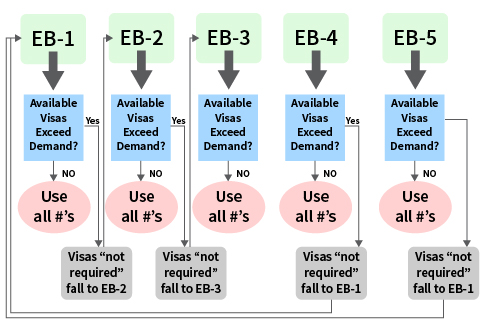
Q4. Why has DOS retrogressed (set back) certain Final Action Dates or applied new Final Action Dates in the Visa Bulletin for October 2022?
A4. In setting the first Visa Bulletin of the fiscal year each October, DOS makes reasonable estimates of the available employment-based immigrant visas in each category. It then, in collaboration with USCIS, reviews the pending inventory of adjustment of status and immigrant visa applications, makes reasonable estimates of new applications, estimates how many of the pending and newly filed applications are likely to result in visa use during the fiscal year, and compares those values to the available visas.
When estimating how many pending or newly filed applications are likely to result in visa use during a fiscal year, the agencies consider a variety of factors, including but not limited to:
the potential that a certain percentage of applications will not be approved; accounting for noncitizens who have multiple pending applications in different categories; estimating and considering the number of family members who may decide to immigrate with the principal applicant; and considering where applications are in the adjudication process and how likely they are to result in visa use in the immediate future. DOS and USCIS also take into account adjustment of status applicants with multiple pending or approved petitions in different EB categories who may decide to transfer between categories based on which category seems most advantageous to them.
When the amount of demand for a particular category (or a country within a category) exceeds the supply of visa numbers available, the category/country is considered “oversubscribed” and DOS applies a cut-off date in the Final Action Dates chart to ensure that visa use remains within the quarterly and annual limits, as well as the category and per-country limits, as established by Congress.
For example in the case of the October 2022 Visa Bulletin, without a retrogression of the Final Action Date for India EB-2, the two agencies would likely use all the available visas within the first few weeks of the fiscal year, in violation of the statute.
Q5. Does retrogression affect my priority date or place in line for an immigrant visa?
A5. If a noncitizen is seeking a visa in a preference category that required a labor certification from the Department of Labor (DOL), their priority date generally is the date DOL accepts the labor certification application for processing. For all other employment-based preference categories, the priority date generally is the date USCIS accepts the underlying petition for processing. Retrogression does not affect your priority date or your place in line for an immigrant visa. You may still receive a visa when one becomes available to you based on that priority date. Retrogression only means that due to the statutory limits, visas are not available to all noncitizens who want them, even if they have already filed an application for adjustment of status.
Q6. My category retrogressed or a Final Action Date was applied. What is my path forward to a Green Card?
A6. When a visa becomes available to you in the future based on the Final Action Date for your country and category as compared to your priority date, USCIS will be able to adjudicate your adjustment of status application. For as long as your I-485 application for adjustment of status is pending, you are eligible to seek certain benefits, among which are:
- You may apply for employment authorization, and that employment authorization, if granted, is not tied to a particular employer, position, or job classification, and is currently granted in increments of up to two years;
- You may apply for advance parole, which, if granted, authorizes you to travel outside of the United States during the advance parole validity period and apply for parole into the United States upon your return (at a U.S. port of entry) without abandoning your adjustment of status application;
- If your adjustment of status application has been pending with USCIS for 180 days or more, you may request to transfer or "port" your application to a qualifying new job offer;
- Depending on the facts of your case, your children who have also applied for adjustment of status as your derivative beneficiaries might not age out of eligibility to adjust status as your derivative beneficiaries; and
- You are considered to be "in a period of stay authorized" and do not accrue unlawful presence while your application is pending.
Q7. When is a derivative child’s applicant age locked under the Child Status Protection Act, and how is that age calculated?
A7. In the employment-based preference categories, a child’s age under the Child Status Protection Act (CSPA) is the child’s biological age at the time of visa availability less the amount of time that the underlying petition was pending, but only if the child sought to acquire status as a lawful permanent resident within one year of the date a visa is available. For more information about when a visa is considered available for CSPA purposes as well as other details about CSPA, please see Volume 7, Part A, Chapter 7 of the USCIS Policy Manual.
Q8. If I am applying for adjustment of status, should I submit Form I-693 with my Form I-485?
A8. USCIS encourages adjustment of status applicants to submit Form I-693, Report of Medical Examination and Vaccination Record, with their Form I-485, Application to Register Permanent Residence or Adjust Status. Doing so will help limit the need for USCIS to send Requests for Evidence, reduce processing times, and aid USCIS as it works with DOS to use all available visas.
Q9. If I did not file a Form I-693 with my pending Form I-485, should I send one in now or wait for USCIS to request it, and why?
A9. Noncitizens with pending adjustment of status applications should not send an unsolicited Form I-693 to us. Given the rapid movement of files between directorates and offices as we strive to optimize resources across the agency, it would be difficult to match an unsolicited Form I-693 with the related adjustment of status applications in a timely and efficient manner. This could delay the adjudication of adjustment of status applications while Forms I-693 are matched up to adjustment applications. We are proactively identifying employment-based adjustment of status applications with available visas that lack a valid Form I-693 and contacting applicants directly to request that form.
If your underlying petition is approved and a visa is available to you, but you know that your previously filed Form I-485 does not have a valid Form I-693, it will help USCIS use the available visas and adjudicate your application if you visit a civil surgeon and have a valid Form I-693 on hand when we send the request to you. The “60-day rule,” which has been temporarily waived, does not apply to Forms I-693 signed by the civil surgeon after you have filed Form I-485.
Q10. My immigrant visa petition has been approved, and I have a pending adjustment of status application. What happens next?
A10. In FY 2023, USCIS intends to transfer the adjustment of status applications in the first three employment-based preference categories from the Texas Service Center (TSC) and Nebraska Service Center (NSC) to the National Benefits Center (NBC) after the approval of the petition. The Field Operations Directorate will adjudicate the adjustment of status applications.
Q11. Why does the data on the USCIS website show such lengthy processing times for employment-based Form I-485s at the Texas Service Center and the Nebraska Service Center?
A11. We understand that it can be disconcerting when the processing times on our website, especially at the Texas Service Center and Nebraska Service Center, are significantly longer than the agency-wide processing times. However, this is the expected result whenever USCIS transitions a workload from one operational component to another. The few applications that remain at the TSC and NSC are those that have already been pending for some time where the centers are completing the adjudication. As the service centers adjudicate the few remaining old applications the reported processing times for those centers will increase.
Q12. How does the transfer of the underlying basis request process work?
A12. We have created a centralized location for the receipt of transfer of underlying basis requests between the employment-based preference categories that are accompanied by a Form I-485 Supplement J. You may submit your written request and completed Supplement J to:
Attn: I-485 Supp J
U.S. Department of Homeland Security
USCIS Western Forms Center
10 Application Way
Montclair, CA 91763-1350
You should only send transfer requests accompanied by a Supplement J to this address, and you should not send other forms, documents, or evidence to this address.
Employment-based transfer requests that are not accompanied by a Supplement J should be submitted in writing to the USCIS office with jurisdiction over your pending I-485 application.
If you have already submitted a transfer request to a USCIS office, you should not submit a new request. All requests to transfer the underlying basis already received or that will be received at a USCIS office will be processed as usual by the USCIS office with jurisdiction over your pending Form I-485.
For transfer requests accompanied by Supplement J submitted to this address at the Western Forms Center, we scan the documents, upload the Supplement J information into our systems (generating a receipt notice), and notify the office or service center that currently holds the related adjustment of status application that the scanned request is available in our electronic systems.
Q13. How does a transfer of underlying basis request affect the calculation of a child’s age under the Child Status Protection Act (CSPA)?
A13. As stated in Volume 7, Part A, Chapter 7 of the USCIS Policy Manual, “[i]f an applicant has multiple approved petitions, the applicant’s CSPA age is calculated using the petition underlying the adjustment of status application.” When we approve a request to transfer the underlying basis of the pending adjustment of status application, we calculate the CSPA age using the approved petition that forms the new basis of the adjustment application. If we transfer an applicant’s underlying basis, then we calculate an eligible applicant’s CSPA age using the applicant’s age at the time the immigrant visa becomes available in the new category minus the time the immigrant petition that forms the new basis of the adjustment of status application was pending.
Q14. If the immigrant visa petition underlying my pending adjustment of status application has not been adjudicated, will this prevent me from transferring the basis to a different petition?
A14. If you have a pending petition, that does not prevent us from granting a request to transfer the underlying basis of your pending Form I-485 to a different Form I-140.
Q15. Why must applicants request to transfer the underlying basis of their pending Form I-485? Why does USCIS not review its records and make the decision for the applicants?
A15. The decision to grant a transfer request is made in the discretion of USCIS. If we grant the transfer request, we will adjudicate the Form I-485 application based on the petition to which the Form I-485 was transferred. If we do not grant the transfer request, we will adjudicate the Form I-485 application based on the petition associated with the Form I-485 application prior to the transfer request.
We do not presume to know whether an adjustment of status applicant would like to transfer their pending Form I-485 application from the petition on which it is currently based to a different petition. We require transfer requests to be in writing from the applicant to ensure that the record accurately reflects the basis on which the applicant requests us to adjudicate the adjustment of status application.
To highlight the importance of applicants making this decision themselves and communicating it to us, here is an example. Consider a noncitizen with a pending Form I-485 who does not have an available visa based on the underlying petition. They have an older approved petition in a different preference category where a visa is available to them. However, the petition was filed over 10 years ago, and the noncitizen no longer has a relationship with the potential employer, or the employer may no longer exist or no longer be willing to employ the noncitizen. As a result, the noncitizen could not adjust status based on that petition.
Q16. Why does USCIS not allow noncitizens to apply for adjustment of status based on the Dates for Filing chart every month of the year?
A16. When we determine that there are immigrant visas available for the filing of additional adjustment of status applications, noncitizens must use the Dates for Filing chart to determine when to file an adjustment of status application with USCIS. Otherwise, use the Final Action Dates chart to determine when to file an adjustment of status application with us. We make this determination monthly based on how many visa numbers remain available for the year, USCIS and DOS visa-available inventory, and operational considerations.
Q17. When does the special exception to the per-country levels for the employment-based categories apply?
A17. Under INA 202(a)(5)(A), if the total number of visas available in one of the employment-based categories for a calendar quarter exceeds the number of qualified immigrants who may otherwise be issued such visas, the visas made available in that category will be issued without regard to the per-country numerical limitation. This can happen as early as the first day of a fiscal year, depending on the relevant data.
Q18. When USCIS adjudicates a principal applicant’s adjustment of status application, does USCIS also adjudicate the adjustment of status applications of the dependent family members? What if dependent family members are not approved before priority dates move back?
A18. USCIS makes every effort to adjudicate the principal and derivative family members at the same time, but this is not always possible. If we deem approvable a Form I-485 of a derivative family member and a visa number is not available, we will request the visa number from DOS, but the case will remain pending until a visa number is available, DOS allocates it, and we complete the adjudication.
Q19. What happens when an EB-3 I-140 downgraded petition is pending and attached to a still-pending Form I-485? Is it true that the EB-3 I-140 does not have to be approved to allow a transfer of underlying basis of the Form I-485 to an approved EB-2 I-140 where the EB-2 priority date is current under the Final Action Dates?
A19. A pending EB-3 petition in this scenario does not prevent USCIS from granting the applicant’s request to transfer the underlying basis of their pending Form I-485 to a separate, approved Form I-140.
Green Card
Frequently Asked Questions on US Travel Ban+
Note: For the NRI readers, The Economic Times has started an immigration helpdesk. A team of experts which includes Rajiv S. Khanna addresses the most pressing issues. Please see the link below.
Q. I am a US citizen and sponsored my parents for immigration to the US. My parents were recently issued an IR-5 immigrant visa. Can they travel to the United States from Delhi?
A. They are not subject to the Indian travel ban. The US State Department has said, “ immigrant visa holders are not subject to Presidential Proclamation 10199 related to India, and they remain excepted from the other geographic COVID proclamations per the Secretary of State.”
Q. I think we will fall under the below category. Is this correct understanding? “any noncitizen who is the parent or legal guardian of a US citizen or lawful permanent resident, provided that the US citizen or lawful permanent resident is unmarried and under the age of 21.” If so, will our approved I-765 EAD and I-131 AP documentation be sufficient for us to travel back to the USA?
A. We have not received any information about your child or children. However, if you have US immigrant or US citizen unmarried children under 21, you are exempt. Additionally, there have been some suggestions from the consulates that AP travelers are also exempt.
Q. I am a US Citizen and my fiancé is an Indian. He is on H-1B status and needs to get his Visa stamped for the first time after going to India. We are planning to register our marriage in the US next month and then travel to India within the next 2 months to get his Visa stamped and do another wedding in front of the family as per Indian culture. Do you think it’s ok to register our marriage before traveling to India and get his Visa stamped? Or is it better to get H-1 stamped with an NIE letter from his employer? Which is safer to reenter the United States? By getting NIE through the employer or by registering our marriage in the US before traveling to India?
A. If he is married to a US citizen, he does not need an NIE. There is no consular discretion involved, whereas obtaining NIE as a single man would be a matter of discretion. So, getting genuinely married would be the obvious choice (not just “registering” a marriage).
Q. I am on an F-1 visa and my parents have a B-2 visa and I am 20 years of age. Can my parents accompany me while going to the USA as this is the first time I’ll be traveling to my university?
A. I see no automatic NIE for this situation. You are excepted, but not your parents.
Q. My wife recently applied for her first H-4 visa after our wedding. She went to the interview at the New Delhi embassy, while I was still in India. Due to the travel ban being implemented during my stay in India, I applied for an NIE 3 times and got rejected each time (I am a software engineer). Her visa was rejected on 221g because the visa officer asked to see my approved NIE in order to grant her a visa. I am currently in a third country and will be entering the USA next week after staying here for 14 days. Since I have not gotten my NIE and am entering the USA via a third country, how should we go about resolving my wife's 221(g)?
A. She will either have to wait for the Covid-19 situation to resolve or go to a third country as you did.
Q. We are Indian citizens and are currently in Belgrade, Serbia to complete 14 days in a third country so that we can proceed to the USA. The reason for this trip is to drop our 19 years old son (with a student visa) at a US university. My 15-year-old son and I are on a tourist visa. I want to know if my younger son and I will be allowed to enter the USA without any problem/ hitch? We are completely Covishield vaccinated except for my 15 years old. Do we need to get PCR COVID testing done Negative before boarding the flight from Belgrade to NYC?
A. Serbia does not appear on any travel restrictions list. The DOS notes, “Travel to the United States directly from Serbia or from a third country that is not covered by the Presidential Proclamation may be possible...” The rest of the information has to do with ever-changing Covid-19 requirements applicable to all nonimmigrants, which you must check before you travel. See, https://www.cdc.gov/coronavirus/2019-ncov/travelers/testing-internation…;
Q. I traveled to India with my wife and my US-born kid on July 21. My H1B visa has expired, but I have a valid H1B extension approval notice (I-797A). I got qualified for Dropbox and paid the fee but I don't see the availability of any slots for appointments. I am eligible for NIE as well since I am working in the healthcare sector. Do I need NIE to travel back to India? My kid is US-born. Does he need to accompany me during the trip to fulfill the NIE eligibility criteria? There are currently no slots available for dropbox appointments? What should I do to schedule an expedited appointment? I contacted the Chennai consulate for NIE approval based on critical infrastructure eligibility criteria. I got a reply from the consulate asking for the documents and visa page. My current visa has expired. What should I do?
A. Getting a visa appointment and NIE are two different problems. You do not need an NIE because you're exempt from the travel ban, and your US-born child does not need to travel with you. The problem of visa stamping still remains. Unless you qualify for an expedited visa appointment, you have to wait. I see no harm in at least trying for an expedited appointment based upon your employment in the healthcare sector.
Q. Can I travel from India to Mexico with an H1B US visa, stay there for 14 days, and then travel to the US?
A. Nonimmigrants can avoid the Indian travel ban but not visa requirements or Covid-19 restrictions applicable to all US-bound travelers. The travel ban can be avoided by going for 14 days to any third country that does not have travel restrictions to the USA. Since you already have a visa, After your 14 day trip outside the US, you just need to comply with the general Covid-19 restrictions applicable to all travelers.
Q. I live in the US with my parents. My father is currently on an H-1B Visa with a green card application in Process. I wish to bring my Grandparents who live in India with a tourist visa to the US. They have been fully vaccinated with 2 doses of government-approved vaccine. Will they be able to travel to the US in the 1st week of September?
A. I see no exception or exemption for your grandparents' travel.
Q. I have an O-2 visa and a 12 month NIE approval. I need to travel with my children from the U.K. to the US. Can I add them to my NIE? What are the rules for dependents if your exemption is already approved? I did apply for them when I did my application and it was rejected. I think because I used their ESTA’s? But I don’t know what other basis I could have put? Surely single mothers must be able to keep their children with them if they have a need to enter the US?
A. You should check with the consulate. Now that you have an NIE, If the children are on a dependent visa, they are also excepted. Therefore, they might need to obtain O-3 visas.
Q. How are my chances to get an NIE as a visual artist/ photographer from a Schengen Country with an O-1 Visa? Second question: my O1 Visa needs to be stamped by a US embassy. It seems that third-country processing isn’t available anywhere right now? If I return with an ESTA visa via e.g Croatia or Turkey my O-1 will not be valid in the US, correct? Do you have any other recommendations on how to get back to my work in the US?
A. If you travel on ESTA, you cannot change status to O-1 within the USA. You will stay and depart while on ESTA. I do not see a visual artist/photographer covered by any exception category. Currently, I do not see any option but to wait
Q. I have a valid visa for the USA and would like to travel to Rep De Panama in the middle of August. The transit time in the USA will be approx 4 hours. Can I travel to Panama and then return via the Dominican Republic after a month to India via Miami staying in Miami for 36 hours?
A. Essentially, you are asking about two matters. Transit through the US and then stay in the US. The DOS notes, “Transiting a country covered by the proclamation, even without exiting the airport, counts as physical presence within that country and triggers the application of the proclamation. The proclamation also applies to traveling through a US airport to get to another country.”
So, you need to confirm the travel restrictions from and to Panama, DR, and the US. This information is available on the State Department Website at: https://travel.state.gov/content/travel/en/traveladvisories/COVID-19-Co…;
Q. I am an Indian Citizen, US Legal Permanent Resident (LPR) residing in Maryland, USA. My parents and sister reside in Mumbai, India. Due to the Covid-19 pandemic, travel between India and the US is restricted. I have not met my parents since July 2020 and my sister since December 2019. I was planning to visit them in India in May 2021 but I canceled my travel plans due to the rising cases in India. I am reaching out to you as I seek clarity on current travel restrictions. Are they applicable to parents and sisters of US LPR?
A. The restrictions apply to your parents and siblings unless you are under the age of 21.
Q. My daughter is a USA citizen, 11years old, and is presently in the USA on vacation. Will I be allowed to travel from the UK to go to the USA to pick her up? I am on a B1/B2 visa and she lives with me but went for the summer holidays to see her grandparents in the USA.
A. You should have no problem from the Indian travel ban perspective. Carry proof of your daughter’s age and your relationship with her. As the US consulates in India note, “qualifying family members do not need a National Interest Exception or any pre-approval from the Embassy or Consulates. Travelers should carry proof of the qualifying relationship (such as a birth or marriage certificate) when initiating travel to the United States.”
Q. I am an industrial engineer working in the private sector in the USA. We are a team of engineers within our company devoted to research and development for industrial control systems. Is there any possibility for us to qualify through the EB1-A category for green cards?
A. There are four possible options for you that I can see from the basic information you have given.
Option one, the extraordinary ability, EB1-A category as you have asked. In this category, the USCIS focuses entirely on your qualifications. Please see https://economictimes.indiatimes.com/nri/migrate/do-you-qualify-for-an-einstein-green-card/articleshow/82768200.cms
Therefore, assessing your possible inclusion in this category requires a review of your resume.
Option two, the outstanding researcher, EB-1B category. In this category, the focus is again on your resume but the threshold for qualifying is lower than that for EB1-A. The requirements for this category for an industrial (non-academic) researcher include the following factors:
Your employer must petition for you.
The offered position must be non-temporary
The employer must have at least three full-time researchers not counting you
The employer must have a record of research or similar achievements
You must possess three years of research (úsually not counting your Master’s degree or Ph.D. research) or teaching experience
Your qualifications must show that your internationally “recognized”
Option three, the national interest waiver (NIW). In this category, the focus is on the work that you do or plan to do. Is the work in the interest of the United States? There are certain other factors that are also examined.
Cybersecurity being a priority, there is a possibility that the work you do on control systems could be in the US national interest. But if you are chargeable to India (chargeability is determined usually by your country of birth) for your green card, this option may not be attractive because NIW is classified under the EB-2 category with years of waiting.
Option four, PERM-based green card which is pursued by a majority of foreign professionals in the United States. This process is also called “labor certification,” which requires a test of the US labor market through newspaper advertisements, etc.
Note: For the NRI readers, The Economic Times has started an immigration helpdesk. A team of
experts which includes Rajiv S. Khanna addresses the most pressing issues. Please see the link below.
Nonimmigrant Visas
Green Card
Citizenship and Naturalization
Immigration Law
H-4 EAD FAQ, Converting from another work status (such as H-1) to H-4 EAD+
H-4 EAD rule, click here for Rajiv's blog entry on H-4 EAD and related FAQs. Scroll down for latest updates.
----------------------------------------------------
We have received several requests about how to ensure there are no gaps in a spouse’s ability to work when converting from another work status (such as H-1) to H-4 EAD.
The short answer, as of now (November 2016) is that here is no way to guarantee that there will not be any gap in a spouse’s ability to work. The problems arise from the fact that there can be a gap between change of status to H-4 and receipt of EAD. The law requires that EAD must be approved and the EAD card must be in hand for the H4 holder to work.
To illustrate some of the scenarios we have been asked to comment upon:
Question: My spouse is currently working on F1 OPT or H1 status. How can he/she change to H4 status and obtain H4 EAD without a gap in the ability to work?
Answer: There is no way to ensure there will be no gap between the current employment authorization and the H4 EAD approval. The H4 and H4 EAD petitions can be filed concurrently, but USCIS has not been adjudicating them at the same time. First, USCIS adjudicates the H4 petition, after which they start working on the H4 EAD petition. As the H4 EAD generally takes about 90 days to be adjudicated, it is best to anticipate H4 EAD approval about 90 days after the H4 approval.
It is possible to request a future start date for the H4 status. The hope would be that by the time the H4 status becomes effective, the H4 EAD is also approved. But again, there is no way to guarantee the time frame.
Question: My spouse entered the US on H4 status. How soon can the H4 EAD be filed and how long will it take before he/she can work?
Answer: The H4 EAD can be filed as soon as the spouse has arrived in the US on H4 status. Because, the USCIS is taking about 90 days to adjudicate the H4 EAD petition, your spouse is likely to be able to start working in about 3 months after the EAD petition is filed.
Question: We need to renew my H1 and my spouse’s H4 and H4 EAD. Would it help the EAD to be issued faster if we file the H1 petition through Premium Processing?
Answer: Possibly. There is no Premium Processing option for H4 or H4 EAD, but as a courtesy, the USCIS often tries to adjudicate H4 and H4 EAD petitions at the same time as the Premium Processing H1 petition. There is no guarantee that the USCIS will adjudicate the H1, H4 and H4 EAD at the same time. It is possible that only the H1 will be adjudicated under Premium Processing, and the H4 and H4 EAD will be adjudicated in the normal queue.
Question: My H1 does not need to be extended, but my spouse’s H4 and/or H4 EAD do need to be renewed. How can the petitions be filed so there is no gap in the H4 EAD authorization to work?
Answer: It is critical to file these petitions early. The H4 renewal can be filed 6 months before the current H4 expires, and the H4 EAD can be filed 180 days before the current H4 EAD expires. While it is not a guarantee that there will be no interruption in the work, early filing is the best option to provide the USCIS with enough time to process the petitions.
Nonimmigrant Visas
I-131 (Reentry Permit) and N-470 FAQ+
I-485 FAQ+
The following questions were asked in today's community conference call. I feel the answers should be of use use to many folks.
Originally posted by Kavita_K View Post Namaste Rajiv ji,
I am on H1-B visa and my EB-2 Priority Date is May 15, 2010. Please see below questions regarding I-485.
Question # 1:- Typically, how long would it take to receive Advance Parole and EAD after filing I-485?
Answer. EAD is usally processed within 90 days and AP within 3-6 months. You can check I-131 processing times from links on this page: http://www.immigration.com/processin...-status-checks
Question # 2:- I entered USA on F1-Visa in year 2000, and then changed my status to H1-B visa within USA in year 2004. I never left USA since year 2000. My passport does not have H1-B visa stamp. In order to file I-485, is it required to have H1-B visa stamp in my passport?
Answer: A visa stamp is NOT required. Proper status only is needed.
Question # 3:-After filing I-485 and before receving A.P., if I travel to my home country for H1-B visa stamping, is it possible that my company can mail A.P. documents to my home country so that I could enter USA using my A.P. in case H1-B visa in my home country is denied?
Answer: It is NOT advisable to travel before AP is issued, if you do not have an H/L visa already stamped. For details, listen to today's recording of the community conference call. It will be posted here: http://www.immigration.com/free-comm...nference-calls
Question # 4:- I came to know that it is required for an alien to be present in USA at the time of I-485 filing. Is it also required that an alien must be present in USA until A.P. is approved?
Answer: Presence in USA for 485 filing is mandatory. See previous answer for AP.
Question # 5:- Does Visa Officer have the ability to cancel A.P., in case H1-B visa is denied in my home country due to 221(g)/missing tax returns/W-2's/Paystubs?
Answer: I do not believe VO has the authority to revoke an AP.
Question # 6:- If my H1-B visa is denied in my home country, and if i enter USA using A.P., then could my spouse enter USA using H-4 visa using my valid I-797 approval notice even though I do not have H1-B visa stamp in my passport? If I enter USA using A.P., what are the options for my spouse? Kindly advise.
Answer: Under Cronin memo, if you enter on AP to continue working on an existing, valid H-1, you are still considered to be on H-1. I believe your spouse can use his H-4.
Question # 7:- At what point of time during GC process, do I need to add my spouse? Should it be before filing of I-485 or before Visa Number is available? Kindly advise me
.
Answer: Before APPROVAL of I-485. Listen to today's community conference call recording for more info: http://www.immigration.com/free-comm...nference-calls
Question # 8:- After filing my I-485, and if my spouse is in USA on H-4, will I be able to add my spouse to my I-485 application? By the time, I want to add my spouse to I-485 application, if Visa Number is available and if AOS/I-485 is approved, then would I still be able to add my spouse if spouse is in USA and also outside USA?
Answer: Your spouse can file his 485 if he is in USA; Priority Dates are current AND he has not been out of status for more than 180 days -- whether or not your 485 is already approved.
Thanks in advance! Happy New Year 2012!!
Kavita
Green Card
H-2A 2010 Rule FAQs Round 13+
The Office of Foreign Labor Certification (OFLC) has published Round 13 of Frequently Asked Questions (FAQs) related to H-2A Applications for Temporary Employment Certification under the 2010 Rule. This round, which covers questions related to H-2A newspaper advertisements, is posted on the OFLC website on the H-2A page, the FAQs page, and the FAQs Rounds page. To directly access the Round 13 FAQs, please click here.
Agency
Nonimmigrant Visas
OFLC has temporarily removed from its website PERM FAQ Round 14 regarding Actual Minimum Requirements+
In light of stakeholder input, which the Office of Foreign Labor Certification (OFLC) is considering, OFLC has temporarily removed from its website PERM FAQ Round 14 regarding Actual Minimum Requirements, originally published on March 6, 2017. OFLC will clarify and republish PERM FAQ Round 14 to provide additional information on its applicability to PERM applications and associated prevailing wage requests and determinations.
For more upcoming updates please visit this link.
Agency
Green Card
DOL Publishes H-2B Interim Final Rule FAQs Round 17+
The Department of Labor has published a seventeenth round of Frequently Asked Questions (FAQs) related to the filing and processing of H-2B Applications for Temporary Employment Certification covering issues related to the area of intended employment and what constitutes a worksite under the H-2B program. The Round 17 FAQs are posted on the H-2B Interim Final Rule Implementation Page on the Office of Foreign Labor Certification website at https://www.foreignlaborcert.doleta.gov/2015_H-2B_IFR.cfm.
Agency
Nonimmigrant Visas
Radio Show, 2015, Jan 14, Immigration Innovation Act & FAQ on Changing Jobs During Green Card+
- Video URL
Green Card
Immigration Law
DOL Releases H-2B Entertainer FAQs+
The Department has released FAQs for H-2Bs in the entertainment industry.
Profession/Occupation
Agency
Nonimmigrant Visas
FAQs on the Executive Order – Protecting the Nation from Foreign Terrorist Entry into the U.S.+
Executive Order on Visas
As of June 29, 2017, we began implementing the Executive Order at our embassies and consulates abroad in compliance with the Supreme Court’s decision and in accordance with the Presidential Memorandum issued on June 14, 2017. Our implementation is in full compliance with the Supreme Court’s decision.
On July 13, 2017 the U.S. District Court in Hawaii issued a ruling regarding the definition of “close familial relationship,” as that phrase was used in the Supreme Court’s June 26, 2017 order on implementing Section 2(c) of E.O. 13780. A close familial relationship for that purpose was previously defined under U.S. Government guidance as a parent (including parent-in-law), spouse, fiancé, child, adult son or daughter, son-in-law, daughter-in-law, sibling, whether whole or half, and including step relationships. The District Court ruled that, in addition to those relationships, grandparents, grandchildren, brothers-in-law, sisters-in-law, aunts and uncles, nephews and nieces, and cousins also be included in the definition of “close familial relationship.”
We do not plan to cancel previously scheduled visa application appointments. In accordance with all applicable court orders, for nationals of the six designated countries, a consular officer will make a determination in the course of the interview whether an applicant otherwise eligible for a visa is exempt from the E.O. or, if not, is eligible for a waiver under the E.O., and may be issued a visa.
The E.O. provides specifically that no visas issued before its effective date will be revoked pursuant to the Executive Order, and the E.O. does not apply to nationals of affected countries who had valid visas on June 29, 2017.
The E.O. further instructs that any individual whose visa was marked revoked or canceled solely as a result of the original E.O. issued on January 27, 2017 (E.O. 13769) will be entitled to a travel document permitting travel to the United States, so that the individual may seek entry. Any individual in this situation who seeks to travel to the United States should contact the closest U.S. embassy or consulate to request a travel document.
FAQs on the Executive Order - Department of Homeland Security
Frequently Asked Questions
What does the Supreme Court’s decision mean for applicants for U.S. visas?
The Supreme Court’s order specified that the suspension of entry provisions in section 2(c) of Executive Order 13780 may not be enforced against foreign nationals who have a credible claim of a bona fide relationship with a person or entity in the United States. All other foreign nationals of the designated countries are subject to the provisions of the Executive Order, which will be implemented worldwide as of June 29, 2017, at 8:00 pm, EDT, taking into account the Supreme Court decision. The Executive Order prohibits the issuance of U.S. visas to nationals of Iran, Libya, Somalia, Sudan, Syria, and Yemen unless they are either exempt or are issued a waiver. Consular officers first determine whether the applicant qualifies for the visa class for which they are applying before considering whether an exemption to the executive order applies or whether the applicant qualifies for a discretionary waiver.
What nonimmigrant visa classes are exempted from the Executive Order, based on the Supreme Court’s order?
The Supreme Court’s order specified that the suspension of entry in section 2(c) of Executive Order 13780 (E.O.) may not be enforced against foreign nationals who have a credible claim of a bona fide relationship with a person or entity in the United States. Applicants seeking B, C-1, C-3, D, or I visas will need to make a credible claim to a consular officer at their visa interview that they have a bona fide close familial relationship with a person in the United States or of a bona fide, formal, documented relationship with an entity in the United States that was formed in the ordinary course, rather than for the purpose of evading the E.O., for the visa applicant to be exempt from the E.O. based on the Supreme Court order. Alternatively, some applicants may qualify for an exemption, and others may qualify for a waiver, in accordance with the E.O. itself. Qualified applicants in nonimmigrant visa categories not listed above are considered exempt from the E.O., because a credible claim of a bona fide relationship with a person or entity in the United States is inherent in the requirements for the visa classification. In all visa adjudications, consular officers may seek additional information, as warranted, to ensure underlying relationships are bona fide, rather than being established for the purpose of unlawfully obtaining a visa, including by evading the E.O.
What immigrant visa classes are exempted from the Executive Order, based on the Supreme Court’s order?
Qualified applicants in the immediate-relative and family-based immigrant visa categories are exempt from the E.O. under the Supreme Court’s order, because having a credible claim of a bona fide close familial relationship is inherent in the requirements for the visa. Likewise, qualified employment-based immigrant visa applicants generally are exempt from the E.O., because they have a credible claim of a bona fide, formal, documented relationship with an entity in the United States formed in the ordinary course. Unlike other employment-based immigrant visa applicants, certain self-petitioning employment-based first preference applicants with no job offer in the United States and special immigrant visas under INA section 101(a)(27) may be subject to the E.O., unless they have a credible claim of a bona fide close familial relationship with a person in the United States or of a bona fide, formal, documented relationship with an entity in the United States that was formed in the ordinary course, rather than for the purpose of evading the E.O. Applicants not exempted based on the Supreme Court’s order still may qualify for an exemption, or may qualify for a waiver, in accordance with the E.O. itself. Likewise, diversity visa applicants will need a credible claim of a bona fide close familial relationship with a person in the United States or of a bona fide, formal, documented relationship with an entity in the United States that was formed in the ordinary course, to be exempted under the provisions of the E.O., or qualify for a waiver, before they can be issued a visa during the suspension, because a relationship with a person or entity in the United States is not required for such visas.
If a principal visa applicant qualifies for an exemption or a waiver under the E.O., does a qualified derivative also get the benefit of the exemption or waiver?
Yes, eligible derivatives of these classifications are also exempt.
Does this Order apply to dual nationals?
This Executive Order does not restrict the travel of dual nationals, so long as they are traveling on the passport of an unrestricted country and, if needed, hold a valid U.S. visa.
Our embassies and consulates around the world will process visa applications and issue nonimmigrant and immigrant visas to otherwise eligible visa applicants who apply with a passport from an unrestricted country, even if they hold dual nationality from one of the six restricted countries.
Does this apply to U.S. Lawful Permanent Residents?
No. As stated in the Order, lawful permanent residents of the United States are not affected by the Executive Order.
Are there special rules for permanent residents of Canada?
Permanent residents of Canada who hold passports of a restricted country can apply for an immigrant or nonimmigrant visa to the United States if the individual presents that passport, and proof of permanent resident status, to a consular officer. These applications must be made at a U.S. consular section in Canada. A consular officer will carefully review each case to determine whether the applicant is affected by the E.O. and, if so, whether the case qualifies for a waiver.
Will you process waivers for those affected by the E.O.? How do I qualify for a waiver to be issued a visa?
As specified in the Executive Order, consular officers may issue visas to nationals of countries identified in the E.O. on a case-by-case basis, when they determine: that issuance is in the national interest, the applicant poses no national security threat to the United States, and denial of the visa would cause undue hardship.
What is a close familial relationship for the purposes of determining if someone is subject to the E.O.?
In light of the July 13, 2017 U.S. District Court of Hawaii ruling regarding the definition of “close familial relationship” as that phrase was used in the Supreme Court’s June 26, 2017 order on implementing Section 2(c) of E.O. 13780, a close familial relationship is defined as a parent (including parent-in-law), spouse, fiancé, child, adult son or daughter, son-in-law, daughter-in-law, sibling, grandparents, grandchildren, brothers-in-law, sisters-in-law, aunts and uncles, nephews and nieces, and cousins. For this purpose, “cousins” are limited to first-cousins (i.e., each cousin has a parent who is a sibling of a parent of the other cousin). For all relationships, half or step status is included (e.g., “half-brother” or “step-sister”). “Close familial relations” does not include any other “extended” family members, such as second-cousins.
My visa was refused under the Executive Order, but I have family members in the United States who I think may qualify as “close familial relations” for purposes of establishing a “bona fide” relationship with a person in the United States. What should I do?
Individuals whose applications for U.S. immigrant and nonimmigrant visas were refused solely based on Executive Order 13780, as informed in writing at the time of the visa interview, who believe they meet the requirement of having a credible claim of a bona fide relationship with a close familial relation in the United States should contact the U.S. embassy or consulate where they applied for a visa with this information. In light of the District Court’s July 13, 2017 order, a close familial relationship is defined as a parent (including parent-in-law), spouse, fiancé, child, adult son or daughter, son-in-law, daughter-in-law, sibling, grandparents, grandchildren, brothers-in-law, sisters-in-law, aunts and uncles, nephews and nieces, and first cousins.
I sponsored my family member for an immigrant visa, and his interview appointment is after the effective date of the Order. Will he still be able to receive a visa?
The Supreme Court’s order specified that section 2(c) of the Executive Order may not be enforced against foreign nationals who have a credible claim of a bona fide close familial relationship with a person or a formal, documented relationship with an entity in the United States that was “formed in the ordinary course, rather than for the purpose of evading [the Executive Order].” One example cited in the Supreme Court’s decision was a foreign national who wishes to enter the United States to live with or visit a family member, thereby demonstrating a bona fide relationship with a person in the United States. Applicants for immigrant visas based on family relationships are excluded from the E.O. under the Supreme Court’s decision if they otherwise qualify for the visa.
Can those needing urgent medical care in the United States still qualify for a visa?
The Executive Order provides several examples of categories of cases that may qualify for a waiver, to be considered on a case-by-case basis when in the national interest, when entry would not threaten national security, and denial would cause undue hardship. Among the examples provided, a foreign national who seeks to enter the United States for urgent medical care may be considered for a waiver.
An individual who wishes to apply for a waiver should apply for a visa and disclose during the visa interview any information that might qualify the individual for a waiver. A consular officer will carefully review each case to determine whether the applicant is affected by the E.O. and, if so, whether the case qualifies for a waiver.
I’m a student or short-term employee that was temporarily outside of the United States when the Executive Order went into effect. Can I return to school/work?
If you have a valid, unexpired visa, the Executive Order does not apply to your return travel.
If you do not have a valid, unexpired visa, the Supreme Court’s decision specified that section 2(c) of the Executive Order may not be enforced against foreign nationals who have a credible claim of a bona fide relationship with a person or entity in the United States. One example cited in the Supreme Court’s decision was a student from a designated country who had been admitted to U.S. university, thereby demonstrating a credible claim of a bona fide relationship with an entity in the United States.
An individual who wishes to apply for a nonimmigrant visa should apply for a visa and disclose during the visa interview any information that might demonstrate that he or she is exempt from section 2(c) of the Executive Order. A consular officer will carefully review each case to determine whether the applicant is affected by the E.O. and, if so, whether the case qualifies for a waiver.
FAQs on the Executive Order - Department of Homeland Security
Profession/Occupation
Agency
Immigration Law
Supervised Recruitment - PERM FAQ 2+
7. What documentation and/or notice is needed when an employer undergoing Supervised Recruitment changes its attorney/agent?
Ans. The employer and/or the newly retained attorney or agent must provide documentation signed by the employer establishing that it intends to be represented by the attorney or agent named, providing all applicable information as requested in Section E, Agent or Attorney Information, of the ETA Form 9089, and containing the statement, "I hereby designate the agent or attorney identified in this letter to represent me for the purpose of labor certification. I take full responsibility for the accuracy of any representations made by the agent or attorney identified above."
8. Can the employer list a wage range in its advertisement(s)?
Ans. Yes. If the employer wishes to state a wage range in the advertisement, the bottom of the range must not be lower than the prevailing wage or the wage being offered to the foreign worker named on the ETA Form 9089, whichever is higher.
9. Must the employer advertise at the prevailing wage it listed at the time of filing the ETA Form 9089 OR, if different, the current prevailing wage?
Ans. Where the employer includes a wage in its advertisement, the wage must be equal to or greater than the current prevailing wage for the job opportunity. Where necessary, the OFLC/ANPC will provide the employer with the new prevailing wage applicable to the job opportunity. If the employer chooses to use a source other than the Occupational Employment Statistics (OES) survey, the employer must provide an acceptable survey, as outlined in 20 CFR 656.40(g), to the Certifying Officer.
10. What is the extent to which the employer must provide any additional information requested in the notification of Supervised Recruitment Letter?
Ans. All documentation required by the OFLC/ANPC as part of the supervised recruitment process must be provided in full. Where one form of documentation lends itself more readily for submission to the OFLC/ANPC, e.g., electronic versus hard copy, arrangements can possibly be made to accommodate the one form over the other.
11. To whom will the Office of Foreign Labor Certification send any resumes received in response to the advertisement(s)?
Ans. Resumes and or applications received by the OFLC/ANPC in response to the employer's advertisement(s) will be sent to the employer's attorney or agent of record, if any, with a copy to the employer. If the employer is not represented by an attorney or agent, the resumes and or applications received by the OFLC/ANPC in response to the employer's advertisement(s) will be sent directly to the employer.
12. What are the consequences of an employer requesting to withdraw an application undergoing Supervised Recruitment?
Ans. While OFLC/ANPC may grant an employer's request to withdraw an application undergoing supervised recruitment and the employer then files a new application meeting all regulatory requirements, the future application for the same foreign worker as in the withdrawn application will be subject to supervised recruitment pursuant to 20 CFR 656.21. Additionally, where the OFLC/ANPC determines it appropriate, all other applications filed by the employer for any foreign worker or job opportunity may also be subject to supervised recruitment.
An employer that wishes to file a future application for the same foreign worker as in an application withdrawn while undergoing supervised recruitment must do so by completing the ETA Form 9089, except Section I, Recruitment Information, which will be completed after submission at the instruction of the OFLC/ANPC. The employer must file the above referenced application by mail to the Atlanta National Processing Center at the following address:
U.S. Department of Labor
Employment and Training Administration
Foreign Labor Certification
National Processing Center
Harris Tower
233 Peachtree Street, Suite 410
Atlanta, Georgia 30333
Repeated requests to withdraw different applications undergoing supervised recruitment will be carefully reviewed and may evidence a pattern or practice of the employer's failure to comply with the supervised recruitment process, and may subject the employer to debarment from the permanent labor certification program for a reasonable period of no more than three years pursuant to 20 CFR 656.31(f)(1)(v).
Green Card
Next Steps On DOMA And FAQ's From The State Department (DOS)+
UNCLASSIFIED
STATE
00112850
AUG 13
SUBJECT: NEXT STEPS ON DOMA
GUIDANCE FOR POSTS
1. On June 26, 2013, the Supreme Court held Section 3 of the Defense of Marriage Act (DOMA) unconstitutional. That decision has manyimmigration related implications for same sex couples.
2. Beginning immediately, consular officers should review visa applications filed by a same sex spouse in the same manner as thosefiled by an opposite sex spouse, unless a specific provision of the federal immigration laws requires a different approach. The VisaOffice (VO) deleted 9 FAM 40.1 N1.1 (a), which limited the word "marriage" for immigration purposes to mean "only a legal unionbetween one man and one woman as husband and wife," and the word "spouse" to mean only "a person of the opposite sex who is a husbandor a wife." A same sex marriage is now valid for immigration purposes, as long as the marriage is recognized in the "place of celebration." A samesex marriage is valid for immigration purposes even if the couple intends ultimately to reside in one of the 37 states that do not recognize samesex marriages. The same sex marriage is valid even if the applicant is applying in a country in which same sex marriage is illegal.
Action Request
3. The Department asks consular sections to identify what types of marriages are available for same sex couples in country and update the reciprocity tables, pursuant to 9 FAM 41.105. This information will be useful for Department and USCIS colleagues adjudicating I-130
petitions.
New Nonimmigrant Visa Policy
4. Starting immediately, same sex spouses and their children are equally eligible for NIV derivative visas. Same sex spouses and their children (stepchildren of the primary applicant when the marriage takes place before the child turns 18) can qualify as derivatives where the law permits issuance of the visa to a spouse or stepchild without being named on a petition (or if a petition is not required). This would include: Diplomat (A), Commonwealth of the Northern Mariana Islands transitional worker (CW), treaty trader investor (E), international organization employee (G), temporary worker (H), information media representative (I), intracompany transferee (L), North Atlantic Treaty Organization (NATO), extraordinary ability (O), entertainer and athlete (P), religious worker (R), and North American Free Trade Agreement (TN) visa categories. If an applicant is otherwise qualified, he/she may be issued a derivative visa starting now.
5. Some NIV classifications require certain documentation before a visa issuance can take place. Same sex spouses (and stepchildren) of F and M student visa applicants (F-2 and M-2) will need to obtain an I-20a prior to issuance. Spouses of exchange visitors (J-2) will need an approved DS-
2019. Same sex spouses of victims of criminal activity (U-2) and human trafficking victims (T-2) will require completed Supplement I-918s or I-914s respectively, before an officer approves any derivative cases.
New Immigrant Visa Policy
6. A spouse of a U.S. citizen, as well as a spouse of a Lawful Permanent Resident (LPR) (when the priority date is current), may apply for an immigrant visa after USCIS approves the I-130. The validity of a marriage will depend on whether it was legally valid in the place of celebration, rather than the place of domicile.
Stepchildren acquired through such marriages are eligible to the same extent as stepchildren acquired through opposite sex marriage. Same sex spouses (and qualified children or stepchildren) can also qualify as dependents of employment based categories and family preference categories, and as follow to join derivatives.
7. Many same sex couples live abroad in countries where they are unable to marry. Starting immediately, same sex partners of U.S. citizens may apply for fiance nonimmigrant K -1 visas to wed in the United States. Once the union is contracted in a state permitting same sex marriage, the foreign spouse may apply for adjustment to LPR status through USCIS, or the U.S. citizen may file an I-130 with USCIS. A significant portion of same sex partners intending to immigrate to the United States may utilize fiance visas.
8. DV applicants may include same sex spouses in their initial entry or add spouses acquired after their initial registration. Follow to join DV 2013 applicants must be issued before the end of FY 2013. Typically, DV applicants who did not include their spouse on their initial entry are disqualified. However, for DV 2013 and DV 2014, same sex couples should not be automatically disqualified for not including their same sex spouse (or stepchildren) on their original entry, since those persons were not recognized as spouses for U.S. immigration purposes at the time of the entry (though the officer should be alert to potential fraud, as with any case in which a spouse is acquired after initial registration).
Public Outreach
9. Posts may use the following points to respond to public and media inquiries as we work with the Department of Justice:
Now that the Supreme Court has found section 3 of the Defense of Marriage Act (DOMA) unconstitutional, the President has directed the Attorney General to work with other members of his Cabinet to review all relevant federal statutes to ensure this decision, including its implications for Federal benefits and obligations, is implemented swiftly and smoothly. We recognize the significance of this decision for affected families, and we are working to implement policy and procedural changes as soon as possible.
Effective immediately, U.S. embassies and consulates can accept visa applications filed on behalf of same sex spouses.
The Department of State is working with the Department of Justice to review all relevant federal statutes and regulations that affect visa processing and immigration benefits. For more information on submitting a visa application, please visit travel.state.gov/visa
11. Minimize considered.
Kerry
UNCLASSIFIED
STATE
00112850
FAQs for Post-Defense of Marriage Act
Q: How does the Supreme Court's Windsor v. United States decision impact immigration law?
A: The Supreme Court has found section 3 of the Defense of Marriage Act (DOMA) unconstitutional. Effective immediately, U.S. embassies and consulates will adjudicate visa applications that are based on a same-sex marriage in the same way that we adjudicate applications for opposite gender spouses. This means that the same sex spouse of a visa applicant coming to the U.S. for any purpose – including work, study, international exchange or as a legal immigrant – will be eligible for a derivative visa. Likewise, stepchildren acquired through same sex marriages can also qualify as beneficiaries or for derivative status.
Q: Do we have to live or intend to live in a state in which same sex marriage is legal in order to qualify for an immigrant or nonimmigrant visa?
A: No. If your marriage is valid in the jurisdiction (U.S. state or foreign country) where it took place, it is valid for immigration purposes. For more information, please review the following page on the United States
Citizenship and Immigration Service's (USCIS) website.
Q: I am in a civil union or domestic partnership; will this be treated the same as a marriage?
A: At this time, only a relationship legally considered to be a marriage in the jurisdiction where it took place establishes eligibility as a spouse for immigration purposes.
Q: I am a U.S. citizen who is engaged to be married to a foreign national of the same sex. We cannot marry in my fiancé's country. What are our options? Can we apply for a fiancé K visa?
A: You may file a Form I-129F and apply for a fiancé(e) (K) visa. As long as all other immigration requirements are met, a same-sex engagement may allow your fiancé to enter the United States for the purpose of marriage. For information on adjusting status, please review the following page on USCIS's website:
Nonimmigrant Visas (NIVs)
Q: Can same sex couples now apply for visas in the same classification?
A: Yes. Starting immediately, same-sex spouses and their children are equally eligible for NIV derivative visas. Same-sex spouses and their children (stepchildren of the primary applicant when the marriage takes place before the child turns 18) can qualify as derivatives where the law permits issuance of the visa to a spouse or stepchild. In cases where additional documentation has always been required of a spouse applying with a principal applicant, such documentation will also be required in the case of a same-sex spouse (see below).
Q: Are there nonimmigrant visa classifications which will require approval of certain documentation before an interview can take place?
A: Yes. Same-sex spouses and stepchildren (F-2 and M-2) of student (F-1 and M-1) visa applicants will need to obtain an I-20A prior to application. Spouses (J-2s) of exchange visitors (J-1) visa holders will need an approved DS-2019. Finally, same-sex spouses of victims of criminal activity (U-2s) and human trafficking victims (T-2s) will require completed Supplement A to Form I-918 or I-914, respectively, before an officer approves any derivative cases. This additional documentation is also required for opposite gender spouses.
Immigrant Visas
Q: My foreign national spouse has children. Can they also be included with my spouse's case?
A: Yes, the children of foreign national spouses can be considered "step-children" of the U.S. citizens and can therefore benefit from a petition filed on their behalf in the IR2 category. In other categories, stepchildren acquired through same sex marriage can qualify as beneficiaries (F2A) or for derivative status (F3, F4, E1-E4, or DV). You and your spouse must have married before the child turned 18.
Citizenship and Naturalization
Nonimmigrant Visas
Green Card
USCIS Publishes FAQ On Filing A Provisional Unlawful Presence Waiver+
USCIS frequently asked questions (FAQ) document on a new process that will allow certain spouses, children & parents of a U.S. citizen to apply for a provisional unlawful presence waiver while they are still in the United States.
Please check the attached document for detail.
Nonimmigrant Visas
DHS Releases FAQs On Deferred Action For Eligible DREAMers+
DHS FAQs on the deferred action process for certain young people who were brought to the U.S. as young children, including information on who is eligible to receive deferred action, how the directive will be implemented, eligibility for employment authorization, and more.
Agency
Immigration Law
DOL FAQ on Foreign Labor Recruiter List+
U.S. Department of Labor Employment and Training Administration OFFICE OF FOREIGN LABOR CERTIFICATION 2015 H-2B Interim Final Rule FAQs Round 16: Foreign Labor Recruiter List 1. What is the Foreign Labor Recruiter List? The Office of Foreign Labor Certification (OFLC) compiles a list of people and entities that employers have indicated that they engage or plan to engage to carry out the recruitment of prospective H-2B workers (“foreign labor recruiters”). See 20 CFR 655.9. This publicly available list contains the names and geographic locations (city, state, country, as applicable) of all foreign labor recruiters that employers disclose in the H-2B temporary labor certification process, including the names and geographic location of persons or entities working for the recruiters. Note: The Department does not endorse or vouch for any foreign labor agent or recruiter included in the Foreign Labor Recruiter List, nor does inclusion on this list signify that the recruiter is in compliance with the H-2B program. The list is simply a list of current recruiters being used by employers in the H-2B program that are disclosed pursuant to the regulation to the Department. 2. Why is the Department compiling a list of agents and recruiters employers engage or plan to engage in the recruitment of prospective H-2B workers and publishing this Foreign Labor Recruiter List? The 2015 H-2B Interim Final Rule (IFR) at 20 CFR 655.9(c) requires the Department to make publicly available a list of foreign labor recruiters that employers engage or plan to engage in the recruitment of H-2B workers. As discussed in the preamble to the 2015 H-2B IFR, by maintaining and publishing a list of foreign labor recruiters, the Department is better poised to enforce recruitment violations, and workers are better protected against fraudulent recruiting schemes by enabling them to verify whether a recruiter is in fact recruiting for legitimate H-2B job opportunities in the United States. In addition, a list of foreign labor recruiters will facilitate information sharing between the Department of Labor, the Department of Homeland Security and the public, and assist the Departments, other agencies, workers, and community and worker advocates to better understand the roles of recruiters and their agents in the recruitment chain and permit a closer examination of applications or certifications involving recruiters who may be engaged in improper behavior. Information about the identity of foreign labor recruiters employers engage or plan to engage to recruit for specific job opportunities will also assist DOL in more appropriately directing its audits and investigations. In turn, strengthening enforcement of recruitment abuses also ensures that compliant U.S. employers are not undercut by unscrupulous employers, such as those who pass on fees to workers. See 80 FR 24042, 24057 (Apr. 29, 2015). 3. Where does the Department obtain the data for the Foreign Labor Recruiter List? When filing a Form ETA-9142B, H-2B Application for Temporary Employment Certification, employers and their attorneys and agents must provide copies of all agreements with any foreign labor agent or recruiter they have engaged, or whom they plan to engage, in the recruitment of H-2B workers. The Department will not make the agreements public unless required by law. OFLC obtains the identities and geographic locations of the foreign labor agents and recruiters from the agreements for public disclosure, as required by 20 CFR 655.9(c). Employers and their attorneys and agents must also disclose the identities and locations of all persons and entities hired by or working for the foreign labor recruiter or agent as well as any of the agents or employees working for those persons and entities (i.e. the secondary recruiters) in the recruitment of prospective H-2B workers. This information, obtained from H-2B applications, provides the data for the Foreign Labor Recruiter List. Together with the identity and geographic location data for each foreign labor recruiter disclosed, the Foreign Labor Recruiter List identifies the last six digits of the Chicago National Processing Center case number associated with the Form(s) ETA-9142B in which an employer identified the foreign labor recruiter. The six digit number can be used to look up the H-2B Job Order and Application for Temporary Employment Certification in the H-2B Public Job Registry located at https://icert.doleta.gov/index.cfm?event=ehLCJRExternal.dspQuickJobOrde… ch by entering the number into the “ETA Case Number” field, selecting “H-2B” in the “Case Type” field and clicking the “Search” button. 4. How often will the Department update the Foreign Labor Recruiter List? The Department will update the Foreign Labor Recruiter List on a quarterly basis. OFLC will post an announcement on its Web site at https://www.foreignlaborcert.doleta.gov/ when updates are available. In addition to checking the OFLC Web site for announcements and updates, we encourage you to subscribe to OFLC Web site updates to receive alerts and notifications.
Agency
Nonimmigrant Visas
USCIS Publishes Revised DOMA FAQs+
Statement from Secretary of Homeland Security Janet Napolitano on July 1, 2013:
“After last week’s decision by the Supreme Court holding that Section 3 of the Defense of Marriage Act (DOMA) is unconstitutional, President Obama directed federal departments to ensure the decision and its implication for federal benefits for same-sex legally married couples are implemented swiftly and smoothly. To that end, effective immediately, I have directed U.S. Citizenship and Immigration Services (USCIS) to review immigration visa petitions filed on behalf of a same-sex spouse in the same manner as those filed on behalf of an opposite-sex spouse.”
Frequently Asked Questions
Petitioning for my Spouse
Q1: I am a U.S. citizen or lawful permanent resident in a same-sex marriage to a foreign national. Can I now sponsor my spouse for a family-based immigrant visa? NEW
A1: Yes, you can file the petition. You may file a Form I-130 (and any applicable accompanying application). Your eligibility to petition for your spouse, and your spouse’s admissibility as an immigrant at the immigration visa application or adjustment of status stage, will be determined according to applicable immigration law and will not be denied as a result of the same-sex nature of your marriage.
Q2. I am a U.S. citizen who is engaged to be married to a foreign national of the same sex. Can I file a fiancé or fiancée petition for him or her?
A2. Yes. You may file a Form I-129F. As long as all other immigration requirements are met, a same-sex engagement may allow your fiancé to enter the United States for marriage.
Q3: My spouse and I were married in a U.S. state or a foreign country that recognizes same-sex marriage, but we live in a state that does not. Can I file an immigrant visa petition for my spouse? NEW
A3: Yes. As a general matter, the law of the place where the marriage was celebrated determines whether the marriage is legally valid for immigration purposes. Just as USCIS applies all relevant laws to determine the validity of an opposite-sex marriage, we will apply all relevant laws to determine the validity of a same-sex marriage..
Applying for Benefits
New Applications and Petitions:
Q4. Do I have to wait until USCIS issues new regulations, guidance or forms to apply for benefits based upon the Supreme Court decision in Windsor?
A4. No. You may apply right away for benefits for which you believe you are eligible.
Previously Submitted Applications and Petitions:
Q5. My Form I-130, or other petition or application, was previously denied solely because of DOMA. What should I do?
A5. USCIS will reopen those petitions or applications that were denied solely because of DOMA section 3. If such a case is known to us or brought to our attention, USCIS will reconsider its prior decision, as well as reopen associated applications to the extent they were also denied as a result of the denial of the Form I-130 (such as concurrently filed Forms I-485).
- USCIS will make a concerted effort to identify denials of I-130 petitions that occurred on the basis of DOMA section 3 after February 23, 2011. USCIS will also make a concerted effort to notify you (the petitioner), at your last known address, of the reopening and request updated information in support of your petition.
- To alert USCIS of an I-130 petition that you believe falls within this category, USCIS recommends that you send an e-mail from an account that can receive replies to USCIS at USCIS-626@uscis.dhs.gov stating that you have a pending petition. USCIS will reply to that message with follow-up questions as necessary to update your petition for processing. (DHS has sought to keep track of DOMA denials that occurred after the President determined not to defend Section 3 of DOMA on February 23, 2011, although to ensure that DHS is aware of your denial, please feel free to alert USCIS if you believe your application falls within this category.)
- For denials of I-130 petitions that occurred prior to February 23, 2011, you must notify USCIS by March 31, 2014, in order for USCIS to act on its own to reopen your I-130 petition. Please notify USCIS by sending an e-mail to USCIS at USCIS-626@uscis.dhs.gov and noting that you believe that your petition was denied on the basis of DOMA section 3.
Once your I-130 petition is reopened, it will be considered anew—without regard to DOMA section 3—based upon the information previously submitted and any new information provided. USCIS will also concurrently reopen associated applications as may be necessary to the extent they also were denied as a result of the denial of the I-130 petition (such as concurrently filed Form I-485 applications).
Additionally, if your work authorization was denied or revoked based upon the denial of the Form I-485, the denial or revocation will be concurrently reconsidered, and a new Employment Authorization Document issued, to the extent necessary. If a decision cannot be rendered immediately on a reopened adjustment of status application, USCIS will either (1) immediately process any pending or denied application for employment authorization or (2) reopen and approve any previously revoked application for employment authorization. If USCIS has already obtained the applicant’s biometric information at an Application Support Center (ASC), a new Employment Authorization Document (EAD) will be produced and delivered without any further action by the applicant. In cases where USCIS has not yet obtained the required biometric information, the applicant will be scheduled for an ASC appointment.
- If another type of petition or application (other than an I-130 petition or associated application) was denied based solely upon DOMA section 3, please notify USCIS by March 31, 2014, by sending an e-mail to USCIS at USCIS-626@uscis.dhs.gov as directed above. USCIS will promptly consider whether reopening of that petition or application is appropriate under the law and the circumstances presented.
No fee will be required to request USCIS to consider reopening your petition or application pursuant to this procedure. In the alternative to this procedure, you may file a new petition or application to the extent provided by law and according to the form instructions including payment of applicable fees as directed.
Changes in Eligibility Based on Same-Sex Marriage
Q6. What about immigration benefits other than for immediate relatives, family-preference immigrants, and fiancés or fiancées? In cases where the immigration laws condition the benefit on the existence of a “marriage” or on one’s status as a “spouse,” will same-sex marriages qualify as marriages for purposes of these benefits?
A6. Yes. Under the U.S. immigration laws, eligibility for a wide range of benefits depends on the meanings of the terms “marriage” or “spouse.” Examples include (but are not limited to) an alien who seeks to qualify as a spouse accompanying or following to join a family-sponsored immigrant, an employment-based immigrant, certain subcategories of nonimmigrants, or an alien who has been granted refugee status or asylum. In all of these cases, a same-sex marriage will be treated exactly the same as an opposite-sex marriage.
Q7. If I am seeking admission under a program that requires me to be a “child,” a “son or daughter,” a “parent,” or a “brother or sister” of a U.S. citizen or of a lawful permanent resident, could a same-sex marriage affect my eligibility?
A7. There are some situations in which either the individual’s own marriage, or that of his or her parents, can affect whether the individual will qualify as a “child,” a “son or daughter,” a “parent,” or a “brother or sister” of a U.S. citizen or of a lawful permanent resident. In these cases, same-sex marriages will be treated exactly the same as opposite-sex marriages.
Residency Requirements
Q8. Can same-sex marriages, like opposite-sex marriages, reduce the residence period required for naturalization?
A8. Yes. As a general matter, naturalization requires five years of residence in the United States following admission as a lawful permanent resident. But, according to the immigration laws, naturalization is available after a required residence period of three years, if during that three year period you have been living in “marital union” with a U.S. citizen “spouse” and your spouse has been a United States citizen. For this purpose, same-sex marriages will be treated exactly the same as opposite-sex marriages.
Inadmissibility Waivers
Q9. I know that the immigration laws allow discretionary waivers of certain inadmissibility grounds under certain circumstances. For some of those waivers, the person has to be the “spouse” or other family member of a U.S. citizen or of a lawful permanent resident. In cases where the required family relationship depends on whether the individual or the individual’s parents meet the definition of “spouse,” will same-sex marriages count for that purpose?
A9.Yes. Whenever the immigration laws condition eligibility for a waiver on the existence of a “marriage” or status as a “spouse,” same-sex marriages will be treated exactly the same as opposite-sex marriages.
Last updated: 08/02/2013